
Youth Justice Inspection Guidance Manual
v1.6 July 2026
1.1. Statement of purpose (Back to top)
His Majesty’s Inspectorate of Probation is the independent inspector of youth justice and probation services in England and Wales. We set the standards that shine a light on the quality and impact of these services. Our inspections, reviews, research and effective practice products provide authoritative and evidence-based judgements and guidance. We use our voice to drive system change, with a focus on inclusion and diversity. Our scrutiny leads to improved outcomes for individuals and communities.
1.2. Values (Back to top)
Influential
We care about making a positive impact on the organisations we inspect and the individuals they work with.
Independent
We ensure that the judgements we make are supported by evidence and are fair and impartial.
Professional
We work in a respectful, transparent, professional way, listening to and sharing learning internally and externally.
Inclusive
We work as one HM Inspectorate of Probation, valuing and respecting each other’s viewpoint and skills, so that everyone feels a part of what we do.
Diverse
We are passionate about diversity and the value that comes through giving everyone a voice in our inspections and the chance to succeed in our organisation.
1.3. Our mandate (Back to top)
HM Chief Inspector of Probation’s responsibilities are set out in section 7 of the Criminal Justice and Court Services Act 2000, as amended by the Offender Management Act 2007 section 12(3)(a). This requires the Chief Inspector to inspect (section 1) and report to the Secretary of State (section 3) on the arrangements for the provision of probation services.
Under section 7(6) of the Criminal Justice and Court Services Act 2000, HM Chief Inspector of Probation also inspects and reports on youth justice services (YJS), established under the Crime and Disorder Act 1998 section 39, and bodies acting on their behalf.
In September 2024 this was amended to include the inspection of how YJS work with victims.
A memorandum of understanding (MoU) is in place between HM Inspectorate of Probation and the Youth Justice Board for England and Wales (YJB). The MoU sets out for the public the key roles and responsibilities of these bodies in conducting the monitoring and oversight of youth justice services in England and Wales. It also sets out an agreement between these bodies on how they will work together to achieve the most effective oversight and understanding of the youth justice system.[1]
We are the independent source of fair comment for ministers and the public on the effectiveness of the work of probation and youth justice providers. Based on our independence, expertise and experience, we can focus uniquely on identifying effective practice. We identify when our standards are being delivered well and highlight examples of this.
Through our inspections, we test the effectiveness of provision and provide assurance. We make recommendations to identify and disseminate effective practice, challenge poor performance and encourage improvement. By doing so, we provide evidence-based intelligence for commissioners and providers, designed to play a key part in facilitating and encouraging improvement in service delivery.
1.4. Inspecting in Wales (Back to top)
HM Inspectorate of Probation recognises the unique legal context of Wales, the importance of the Youth Justice Blueprint, and the impact of devolved areas of responsibility. Justice services in Wales are centrally governed, but many of the statutory and non-statutory agencies in YJS are devolved, including social care, education, health, housing and youth services. We consider the impact of devolved law when inspecting in Wales and ensure that the language we use is consistent with the terminology used in legislation and national policies. Inspection teams delivering services in Wales are provided with guidance on inspecting in a Welsh context.
Welsh language scheme
In accordance with the Welsh Language Act 1993, HM Inspectorate of Probation has adopted the principle that when conducting inspections in Wales it will treat the Welsh and English languages equally. HM Inspectorate of Probation has a Welsh Language Scheme that sets out how we deliver services in Welsh.[2]
For inspections in Wales, we aim for at least one member of the inspection team to be a Welsh speaker. Where that is not possible, we arrange for a translator to work on site with the inspection team. Key documents, including surveys, are provided in English and Welsh. Meetings and case inspection interviews are conducted in Welsh if requested. The inspection report is published in English and Welsh on our website.
1.5. Expectations of inspected bodies (Back to top)
We expect inspected bodies to uphold the highest professional standards. In meeting this expectation, inspected services should:
- be courteous and professional, treating our inspection and inspection support staff with respect
- approach the inspection with integrity and be open, transparent and honest. This includes providing evidence – or access to evidence – that will enable the inspectorate to report honestly, fairly and reliably about the service being inspected. It means not withholding or concealing evidence, or providing false, misleading, inaccurate, or incomplete information
- provide access to case management systems and records
- work with inspectors to take all reasonable steps to minimise disruption, stress and bureaucracy
- ensure the safety of inspectors while on their premises
- maintain constructive professional dialogue with the lead inspector and the inspection team
- bring any concerns about the inspection to the attention of the lead inspector promptly.
2. Overview of youth inspection
2.1. Introduction (Back to top)
The term youth justice service (YJS) is used throughout this document to describe the provision of youth justice services regardless of how they are structured and named locally. We recognise that the term youth offending team is used in the Crime and Disorder Act 1998.
In our work with YJS, we use the terms ‘child’ or ‘children’ to denote children’s special legal status, and to highlight the obligations of relevant agencies such as social care, education and health to meet their safety and wellbeing needs.
We use the term ‘head of service’ to refer to the senior manager with overall accountability for a YJS but recognise that this role can be delivered in different ways.
The framework for inspecting youth justice services runs from 2025. Key features of the programme are:
- introduction of the victims standard
- putting work with children and victims at the forefront of our inspections
- inspecting all YJS against the same core standards, while being proportionate in our inspection activity
- being more agile, and targeting inspection activity when and where it is most needed
- having a rolling inspection programme.
2.2. Rationale for inspecting work undertaken with victims (Back to top)
Why
YJS have a statutory duty to work with victims; there is a renewed focus on the work of criminal justice agencies with victims through the Victims and Prisoners Act 2024. Many victims that YJS work with are children themselves, often children who are already working with a YJS on their own court disposal or out-of-court resolution. We want to see that YJS have the right organisational arrangements in place to support high-quality work with victims, and we want to see this translate into high-quality, individualised and responsive work with individual victims.
In our 2018–2024 programme of youth justice inspections, we looked at victim work that was delivered as part of the work that YJS undertook with a child. We did not look at the organisational arrangements and activity for delivering services to victims, nor did we look at the service provided to victims through the lens of the victim. This is something that we have addressed in our arrangements for youth justice inspection from 2025 onwards. Through our extensive consultation in 2023/2024, we received unanimous support for inspecting a standard for victims in this way.
What
Through a dedicated victims’ standard, we inspect both the organisational arrangements and activity that underpin a YJS’s work with victims and the frontline delivery of this work. Some victims will be adults, and some will be children; some may be children who are working with the YJS already because they have committed an offence. In such instances the work done with them in their capacity as a victim will be judged separately from the quality of work delivered to them as part of their YJS intervention.
How
The victims’ standard sits outside domains one and two (see ‘Standards for inspection’ below), and as such is a ‘standalone’ standard. The standard consists of two key questions:
- Question V1.1 looks at the sufficiency of frontline delivery to individual victims, with inspectors examining case records and undertaking case interviews with staff.
- Question V1.2 looks at the arrangements and activity for work with victims, with inspectors using qualitative evidence to make judgements.
As with all our standards, full guidance underpins the two key questions to ensure validity, fairness and consistency.
When
We inspect work with victims in both inspections of youth justice work with children and victims (IYJWCV) and inspections of youth justice services (IYJS) against the same standard, with the same expectations and with the rating generated in the same way. This ensures fairness and consistency in our inspections of victim work, regardless of the type of inspection a YJS has.
To ensure that this approach continues to be the most fair, valid, reliable, consistent and robust way to inspect and rate a YJS’s work with victims, we will review our approach in 2026.
2.3. Standards for inspection (Back to top)
Our inspection standards are based on a set of principles that we think YJS should meet, to deliver high-quality youth justice practice. They are based on established models and frameworks, and are grounded in evidence, learning and experience.
Our youth justice inspection standards are split into two domains and a victims’ standard. They are structured separately to allow us to judge and rate specific areas of work. However, the domains do not operate in isolation. Domain one covers organisational arrangements, with standards for governance and leadership, staffing, and partnerships and services. Domain two covers the quality of the YJS’s work with children, with standards for assessing, planning, and the delivery of work with children who are subject to court disposals (including custody and resettlement) or out-of-court resolutions, and children who are receiving bail or remand supervision or support. The victims’ standard is a distinct standard. It covers the quality of services delivered to victims under the Victims’ Code (V1.1) and the organisational arrangements that support services for victims (V1.2).
Each standard is underpinned by key questions and prompts, which aim to be coherent, comprehensive and balanced. Key questions set clear benchmarks in terms of quality, against which inspection judgements are made. Under each key question is a set of prompt questions. Prompt questions help inspectors to support their judgements against each key question.
Figure 1: The standards structure
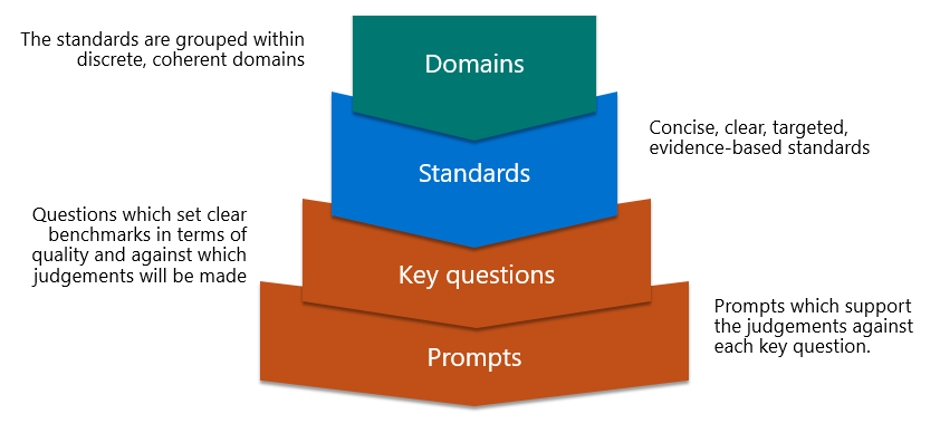
We have developed guidance for each standard. This explains how evidence should be assessed and how we form judgements against key questions and prompt questions. The purpose of the guidance is to provide advice, consistency and a shared understanding of the required expectations.
The guidance material is separated into the following documents:[3]
- Youth justice inspections rules and guidance (RaG): these determine our judgements for domain one and the organisational arrangements that support services for victims (victims’ standard V1.2)
- Child and victim case inspection: case assessment rules and guidance (CARaG): these determine our judgements for domain two and work with victims (victims’ standard V1.1).
Purpose of the case assessment rules and guidance for inspecting work with children and victims
The CARaG is a comprehensive set of published rules and guidance that inspectors and local assessors follow when assessing individual cases for children and victims. It promotes transparency and consistency in our inspection of cases.
The CARaG provides guidance on the key questions and prompts. It is updated regularly to ensure the guidance remains consistent with any changes that we make at standard, question and prompt level, and so that it remains linked to evidence. The CARaG also contains links, where relevant, to more detailed guidance.
2.4. Inspection principles (Back to top)
We assess quality, for example the quality of assessing activity, rather than the specifics of a process or the use of any particular tool. The wording of our key questions and prompts reflects this.
We decide on a rating based on what and how a YJS is achieving against our standards. We consider the performance of the organisation at the time we inspect and, typically, do not make judgements about how policy and practices may influence future impact. However, we will acknowledge effort in the report narrative.
2.5. Confidentiality (Back to top)
In group meetings and case interviews with practitioners, we provide assurance that information shared will only be used in an aggregated form and will not identify individual staff members or individual children’s cases, unless immediate action is needed to protect an individual. The exception to this is cases scheduled for multi-agency case discussions. These are reviewed by YJS managers in collaboration with the case manager and partners before the inspection fieldwork, and a multi-agency discussion is held during fieldwork, which involves a number of individuals.
We will anonymise information before including it in publications. However, information is not treated as confidential, in that we reserve the right to use all information that we obtain throughout our inspection activity. This extends to all information provided to us in writing or verbally by staff or partners either working for the inspected organisation or under contract to that organisation. Similarly, information provided to us by stakeholders, children, parents and carers invited to contribute to the inspection is not treated as confidential.
2.6. Types of inspection (Back to top)
We want to ensure that the quality of YJS work delivered with children and victims is prioritised in our inspection activity. We see high-quality delivery as a product of effective governance and leadership, the right staffing arrangements and strong partnerships and services. Inspection evidence shows that only in exceptional cases do we see high-quality service delivery despite poor-quality organisational arrangements and activity. We must also target inspection resources to be most effective in driving high-quality services for children and victims.
We have therefore developed two types of inspection:
- inspections of youth justice work with children and victims: where we inspect work with children and victims through our domain two standards and the victims’ standard
- inspections of youth justice services: where we inspect the organisational arrangements and activity through our domain one standards alongside domain two standards and the victims’ standard.
A YJS could receive either type of inspection.
Inspections of youth justice work with children and victims:
- place work delivered with children and victims at the forefront of our inspection activity
- assess and evaluate the quality of work with children to achieve positive change and keep them and communities safe across assessing, planning, and delivery activities
- inspect the quality of work with victims and the organisational arrangements to support victims
- are carried out over one week
- consider leadership and governance, staffing, partnerships, and services through the lens of the work delivered to children and victims – therefore, this type of inspection will only rate domain two and the victims’ standard
- form most of our inspection activity.
Inspections of youth justice services:
- assess and evaluate the organisational arrangements and activity (governance and leadership, staffing, partnerships and services) that support the work with children
- assess and evaluate the quality of work with children to achieve positive change and keep them and communities safe across assessing, planning and delivery activities
- assess and evaluate the quality of work with victims and the organisational arrangements to support victims
- are carried out over two weeks
- result in ratings for domain one, domain two and the victims’ standard
- form a smaller proportion of our inspection activity
- are carried out in both a planned and reactive way (see below for more information).
2.7. Decisions about how and where we inspect (Back to top)
As highlighted, we want to ensure that the quality of delivery to children and victims is at the forefront of our inspections. Reporting on work to achieve positive change and keep children and communities safe must be our priority. Therefore, the domain two standards and victims’ standard are the ones that we will look at in every inspection.
There are two routes by which a YJS can be subject to an IYJS inspection. The first route is through a planned IYJS. This is determined by the data and intelligence that we have about YJS. We take both risk-based and random approaches to selecting services for these planned inspections. This helps us to make decisions about where to inspect services, for example geographically, where we may have concerns, and where we expect to see effective practice.
The second route is through a reactive IYJS. In these cases, we are either concerned by our findings from an IYJWCV, or we have seen significant effective practice through the IYJWCV and wish to find out more about how the service has achieved this. In either of these situations, we may return to the YJS after a short period (normally four to six weeks) to inspect the work against the domain one standards. This enables us to understand and report on the enablers of and barriers to the poor or effective practice that we saw in our inspection of frontline work with children and victims. We will not inspect a fresh sample of work; instead, the purpose is to understand how governance and leadership, staffing, and partnerships and services have contributed to what we have seen in work with children and victims. We will undertake a small number of these inspections each year. A YJS will be informed of our decision to return following the ratification meeting.
In making our decisions about whether to return for an IYJS, we follow three principles:
Impact: we will inspect where we can best drive improvement or where we think there is significant effective practice that others can learn from.
Fairness: we will make decisions based only on the evidence and findings from the IYJWCV.
Flexibility: we will not have a set of restrictive criteria but will consider on a case-by-case basis those YJS that fall within the following parameters:
- where we have significant concerns that may have come from, for example, inadequate ratings, an organisational alert or evidence from the IYJWCV inspection
- where we have seen evidence of significant effective practice.
3. Inspection stages: pre-fieldwork and planning
3.1. Pre-fieldwork activity (Back to top)
The inspectorate’s information and data team collate key documents and background information to support the lead inspector in planning the inspection.
Background information
The background information for inspections includes information about previous inspection activity and demographic information about children in the YJS area. This includes population and offending rates, split by ethnicity, sex and age; published data on caseload, performance, crime levels, proven reoffending, and education, training and employment (ETE); offending by children who are looked after; and population characteristics. The lead inspector assesses and analyses this information before fieldwork begins. Other information gathered includes:
- numbers of children supervised in the community
- first-time entrants
- use of custody
- reoffending rates
- previous inspection information
- multi-agency public protection arrangements (MAPPA) data by area
- list of all community safeguarding or public protection incidents
- published Ofsted/Estyn inspections of local authority child safeguarding arrangements/joint targeted area inspections (JTAI) for the previous 12 months and Care Inspectorate Wales inspections of children’s social care
- published Care Quality Commission/Healthcare Inspectorate Wales inspections of drug and alcohol and mental health treatment
- names and addresses of all youth and Crown courts in the area.
3.2. Inspection announcement (Back to top)
Inspections are normally announced on the Wednesday three and half weeks before the fieldwork begins. The announcement is made by telephone, by the lead inspector (or a youth HMI if the lead inspector is not available) to the YJS head of service or the most senior manager available. The inspector will confirm the inspection fieldwork date and the type of inspection (IYJWCV or IYJS). The inspector will confirm a date and time for the planning meeting.
Following the announcement call, the inspected area receives an email confirming the inspection, and a number of guidance documents. These include guidance on submitting evidence in advance, case sample specifications, our narrative template, information about child, parent and carer feedback, the multi-agency case discussion review template and leaflets for staff and partners. We ask the YJS to nominate a single point of contact (SPOC) to work with us to make the necessary arrangements for the fieldwork.
3.3. Announcement letter (Back to top)
The announcement letter provides the inspected organisation with details of key dates, timescales and information about the inspection, covering the whole process, from before fieldwork to after fieldwork.
The YJS receives the announcement letter following the announcement call. The SPOC from the YJS should check the key dates and identify any conflicts with other significant commitments. If there are any issues with the timescales, the SPOC should raise these with the inspection support administrator (ISA), who works with the lead inspector to consider changes where necessary. The YJS should ensure all relevant staff involved in the inspection planning process are familiar with the key dates.
3.4. Planning meeting (Back to top)
The planning meeting takes place as soon as possible following the announcement call, usually on the Friday of the same week. During the announcement call, lead inspector will discuss who it is appropriate to invite to the planning meeting. The meeting will normally take place using Microsoft Teams.
The lead inspector facilitates the meeting and covers the following:
- the inspection methodology, explaining the standards, domains, processes and ratings, and our approach to inspecting equity, diversity and inclusion
- selection criteria for the case sample of children and victims, how to complete the spreadsheets and the deadline for returning them to HM Inspectorate of Probation
- a discussion about the evidence that needs to be submitted before the inspection
- clarification of the local organisational arrangements, offices where the case assessments will take place and/or an explanation of how inspection activity will be carried out remotely
- case manager and victim worker interviews and scheduling
- how inspectors will obtain feedback from children, parents and carers, including one-to-one meetings, focus groups and text surveys
- proposed meetings, focus groups and other inspection activity
- how the inspection team will respond to any diversity issues or adjustments needed for YJS staff
- proposed context visit and showcase slot
- access to IT, rooms and buildings
- proposed schedules and key dates
- arrangements for the presentation by the Board Chair and touchpoint meetings with the YJS head of service.
IYJS inspections only
The planning meeting additionally considers:
- surveys to be conducted, including surveys of all staff and volunteers, and a youth court representative, and arrangements for publishing survey data
- meetings and inspection activities during the second fieldwork week.
The planning meeting is documented by HM Inspectorate of Probation, including notes on any questions raised by the YJS. A copy of the notes is issued to the SPOC, the ISA and any other relevant people.
3.5. Evidence in advance (Back to top)
We ask the YJS to provide us with evidence in advance, to help us gain an understanding of the context of the work we will be inspecting, and the broader activity that may be impacting on outcomes for children and victims. We provide the YJS with a list of standard evidence required in advance. If any of the requested documents are not available, the YJS should inform the lead inspector. We do not expect documents to be prepared specifically for an inspection. If a policy is in the process of being updated and is in draft format, we will accept this. We request that the YJS uploads its evidence to a specific channel in Microsoft Teams. We send an invitation to the channel to the SPOC for the inspection, and anyone else as requested by the YJS. Exceptionally, if local authority IT arrangements do not allow documents to be uploaded to Microsoft Teams, we arrange for them to be submitted by email.
Based on learning from our inspection programme, the number of documents required is significantly smaller than previously requested. Inspectors may ask for additional evidence at any point, but services should not upload additional documents unless the lead inspector has specifically requested them. Documents containing embedded documents and/or links will not be accepted. Evidence should be recent or current (normally produced within the last 12 months), unless it is a key policy that has been in place for longer.
The evidence in advance that we require for all inspections includes:
- completed YJS narrative document (template sent with announcement letter)
- completed evidence in advance content log (template sent with announcement letter)
- completed organisational data spreadsheet (template sent with announcement letter)
- organisational structure chart, and a structure chart identifying where the service sits within the local authority (there are no templates for these)
- copy of the most recent youth justice strategic plan
- management board minutes from the last 12 months
- most recent submission of key performance indicator data to the YJB, if not included with the board minutes
- analysis of feedback from children, parents and carers, and victims, and accompanying action plans. We do not need to see copies of feedback templates or aggregated data. We specifically want to see evidence of impact and clear evidence of ‘you said/we did’ activity, demonstrating how feedback has impacted on service delivery
- any YJS policies that cover work with children, including those to keep children and communities safe, for example policies on risk of harm, safety and wellbeing, out-of-court resolutions, resettlement, bail and remand, work with victims and restorative practice, and knife crime policies or strategies
- child, parent and carer engagement strategies
- any relevant audits or evaluation of the quality of case management and victim practice, including analysis of victim consent and take-up rates
- directory of projects, activities and services available for children and victims
- overview of staff training for case managers, victim workers and middle managers in last 12 months
- details of any seconded staff, including vacancies
- any available data about the proportions of children aged 10 to 17 in the YJS area who are Black, Asian or minority ethnic (this data may be available from the local authority)
- any available data analysing the protected characteristics of children and victims working with the YJS (including race and ethnic origin, religion, disability, sexual orientation and any other factors for which there is available data), across different disposals
- copies of any equity, diversity, disproportionality and/or inclusion policies and/or action plans to address the impact of findings from data analysis, including any hate crime policies or strategies
- any available data analysing the levels of risk of serious harm and safety and wellbeing of children, across different disposals.
For Welsh services only:
- data, analysis and action plans related to the Welsh language needs of children and victims.
Additional evidence in advance that we require for IYJS inspections includes:
- health and safety policy and process
- lone working policy and procedure
- complaints policy (for staff, children, parents, carers and victims)
- appropriate adults policy and process
- staff induction policy
- staff supervision policy
- appraisal/staff performance policy
- management oversight policy
- travel policy (for children).
Narrative document
We ask the YJS to use this template to explain where the service sees itself with reference to the relevant standards and key questions, according to the type of inspection. This is not a self-assessment, but an opportunity for service leaders to explain where they see the YJS’s strengths and to highlight any areas that they are working to improve. Please note, there is a word limit on this.
Organisational data spreadsheet
This document requests a range of data, including the budget, staff profile, caseloads and services. We request this to allow us to:
- triangulate it with the data collected from other sources, including case managers, on issues such as caseload and staff engagement
- ensure that contextual data is collected in a consistent way across different services
- support further, national-level research and analysis of the factors underlying high-quality youth justice provision, to advance our understanding of effective practice.
We recognise that some services may not be able to provide all the data requested. If data is not available, or does not exactly meet our specifications, the spreadsheet allows the service to explain this. The service should return the organisational data spreadsheet to us by uploading it to the relevant channel in Microsoft Teams.
3.6. Pre-fieldwork meeting: out-of-court resolutions, work with victims and engagement of children, parents and carers (Back to top)
At the planning meeting, we will arrange a specific meeting to help us understand the inspected service’s local arrangements for:
- out-of-court resolutions
- victim services
- engagement of children, parents and carers.
Following this meeting, we may request access to additional written evidence.
3.7. Presentation by the Chair of the YJS management board (Back to top)
On the first day of the fieldwork, there is a presentation by the Board Chair. The lead inspector should be informed in advance if a substitute will deliver the presentation. The YJS head of service or Director of Children’s Services may also attend, if available. If the YJS has other relevant staff they wish to attend, this should be agreed in advance with the lead inspector. Any additional attendees must be able to contribute to our understanding of the work being undertaken by the YJS to meet our inspection standards.
The YJS can do the presentation the week before fieldwork, should they wish. This should be discussed and agreed with the lead inspector.
Guidance on the presentation
There is no prescribed format or template for the initial fieldwork presentation, but areas to cover might include:
- the local context within which the YJS operates
- how the delivery model in the YJS impacts on the quality of work with children and victims, including the strategic approach and partnership arrangements
- an overview of how staffing arrangements impact on the quality of work with children and victims
- key challenges facing the YJS and how these are being addressed
- an overview of how quality assurance has resulted in improvements to work undertaken with children and victims
- any examples of local innovation or partnership working and how these impact on the quality of services delivered to children and victims
- the strategic approach to victim work.
The presentation should directly address the inspection standards and their key questions and prompts. Any specific examples or evidence presented should relate to work carried out within the previous 12 months.
Arrangements for the presentation
One hour is allowed for the presentation, followed by up to 30 minutes for any discussion. The purpose of the discussion is to clarify issues from the presentation and/or identify additional sources of evidence that are relevant to the inspection standards.
An electronic copy (Word, PowerPoint or pdf) of the presentation should be provided to the lead inspector either before or on the day.
3.8. Local assessors (Back to top)
On most youth inspections we include local assessors in the inspection team. The exception is some of the smaller YJS inspections, where local assessors are not used, given the smaller case samples. Local assessors are professionals from other YJS, who work with us on a short-term basis. During inspections, they examine and assess the quality of practice carried out by frontline staff in individual cases against our published inspection standards.
Local assessors:
- will have completed our case inspection training and reached a level of competence before being deployed on inspection
- work with the inspection team during fieldwork, in a location other than their normal place of work (or any other place where they may have a conflict of interest)
- receive support, assistance and oversight from the inspection team while working on inspection.
4. Case samples
4.1. Principles: children (Back to top)
We use a common inspection framework to inspect all cases of children who receive services from the YJS. This includes children subject to custody and resettlement, bail or remand, community sentences, youth conditional cautions, and other out-of-court resolutions where there has been a linked offence. This allows us to focus on the child and how their needs are met, rather than the disposal type.
We do not inspect prevention activity, defined by the YJB as ‘…support and intervention with children (and their parents/carers) who may be displaying behaviours which may indicate underlying needs or vulnerability… The aim being to address unmet needs, safeguard, promote positive outcomes and stop children entering the formal youth justice system.’
We do inspect some diversion activity (informal out-of-court resolutions), defined by the YJB as ‘…where children with a linked offence receive an alternative outcome that does not result in a criminal record, avoids escalation into the formal youth justice system…and may involve the YJS delivering support/intervention that may or may not be voluntary ….’
4.2. Principles: victims (Back to top)
We use a common inspection framework to inspect all cases of victims eligible to receive services from the YJS. This includes any victim who has consented to their information being shared between the police and the YJS, irrespective of the type of offence, the nature or age of the victim, or the type of service provided to the victim.
4.3. Case sample confidence levels (Back to top)
The case samples for youth inspection consist of domain two (children) and victims.
The margin of error (or confidence interval) for our domain two case assessment findings depends on the selected sample size: the larger the sample size as a proportion of the overall caseload, the more certain we can be that our findings reflect the eligible population. Our initial calculations for the required domain two sample sizes have been based on achieving a margin of error of five percentage points and a confidence level of 80 per cent for a random sample of cases that come under the specification for the child case sample and have begun within a two-month period. This means, for example, that if our inspection of a sample of cases shows that 47 per cent are being supervised satisfactorily, we can be 80 per cent sure that the true percentage for the total eligible caseload is between 42 per cent and 52 per cent. Importantly, this assumes that the sample is truly random, which links to the sampling method (see next section). For inspection purposes, we use an 80 per cent confidence level as a guide, which provides a balance between cost-efficiency and statistical precision. We base our calculation on published and unpublished YJB data, and information from previous case samples for individual inspections.
There is no published data about the numbers of eligible victim cases in any single YJS area. To be proportionate to the size of the service and the small number of victim staff in most services, we select a proportionate number of victim cases, depending on the workload of the YJS.
Minimum case sample numbers
The size of anticipated domain two case samples ranges from 14 to 91,and victim case samples range from nine to 24. The total size of the anticipated case sample depends on the workload of the YJS and the number of identified cases within the sample specification.
We estimate the expected number of eligible cases that began within a two-month period in the four sub-groups of the case sample: bail or remand, community sentences, out-of-court resolutions, and resettlement cases. Our estimates are based on published and unpublished YJB data about case commencements, which is based on data submitted by YJS. There is no published data about commencements of bail or remand supervision or support, so we estimate the number of those cases based on previous inspection data. We use these estimates to calculate the number of cases required for a sample with 80 per cent confidence. In some services, due to the volatility of commencement numbers, we may find fewer cases than expected beginning in the expected two-month period. In those circumstances, we would select all the available cases beginning in the two-month period. If there are no cases from any one of the four sub-groups, or if the total number of eligible cases across all types of sentence is less than 25, we ask the service to identify additional cases from within a two- to 12-month timeframe (from the date of announcement), and we will select additional cases from the wider timeframe to try to identify 14 cases, with one case from each category (if available).
4.4. Stratification (Back to top)
We take a stratified sampling approach to selecting the final inspection sample for domain two cases. This is to ensure that we inspect the range of YJS work, across different disposals, wherever there has been a linked offence.
The stratification groups for children are:
- resettlement
- community sentences
- out-of-court resolutions
- bail and remand.
Cases are selected randomly from within each stratification group. We ensure that the proportion of cases in the selected sample in each stratification group closely matches the proportions in the longlist.
No stratification is used for the victim case sample; we use a random selection of cases.
4.5. Specification and selection (Back to top)
Domain two (children) case sample specification
The YJS is asked to provide a case sample longlist of all children within a specific two-month timeframe.
Bail and remand:
- all children who began bail support or bail supervision, or who were remanded into local authority care, a secure children’s home, secure school, secure training centre, or a young offender institution.
Resettlement cases:
- all children sentenced to or released from custody.
Community sentences:
- all children who started a community order
- all children who started a referral order, where a referral order contract was agreed.
Out-of-court resolutions:
- where a youth conditional caution was delivered
- where any other out-of-court resolution was delivered and interventions were delivered by, or on behalf of, the YJS
- where prosecution has been deferred, such as outcome 22/23 cases where the YJS has delivered interventions.
For out-of-court resolutions, we ask the YJS to include any children who have received interventions, including interventions delivered:
- directly by the YJS
- under other local authority arrangements
- on a commissioned basis by another provider
- under any partnership arrangements, such as with a police force or under the auspices of the Police and Crime Commissioner
- as part of piloting new arrangements.
We do not need details of children referred directly by police to interventions, without any involvement of the YJS in assessing, screening or panel discussions.
We may exclude:
- children who have been formally transferred out of the YJS
- looked-after children where the inspected YJS acted as a ‘host’ YJS for the child, and the child is from another area; YJS are asked to indicate whether they were responsible for assessment in that case
- children who have been subject to a multi-agency review.
These cases should still be included on the spreadsheet and the notes column used to explain the circumstances.
We would encourage YJS to use the notes column to give additional and relevant details about each child within the spreadsheet to support the case sampling process.
The ISA organises the longlist and applies the stratification.
The ISA then randomly selects the required number of cases from the eligible cases in each stratification group, avoiding excluded cases but matching the case type stratification proportions.
If there are fewer cases than anticipated in any stratification group, we select all available cases but do not extend the timeframe. If there are no children in any individual stratification group within the normal timeframe, or if the total number of children identified is less than 25, we use an extended date range to identify additional cases. We aim to inspect a minimum of 14 cases in every service. These arrangements are discussed in more detail at the planning meeting.
Victim case sample selection
The YJS is asked to provide a longlist of all victims, where the YJS had received the contact details of victims who had consented to be contacted (irrespective of whether this contact actually took place) within a specific timeframe. The longlist should include victims living outside the area covered by the YJS. We do not inspect victim cases where no contact details have been received from the police or where victims have not consented to receive YJS support. The ISA selects a number of victim cases randomly from the longlist.
More detail about sampling arrangements is provided in the case sample specification sent to a YJS when we announce an inspection. This is discussed in detail at the planning meeting.
Equity, diversity and inclusion
We do not select cases with specific protected characteristics or diversity issues or seek to boost the numbers of cases with specific characteristics, because that can skew the overall sample and data. Individual children are shaped through differing combinations of interconnected and overlapping characteristics, experiences and circumstances, and each child’s will be different. Our sampling approach therefore provides an opportunity for the range of children’s protected characteristics to be included, without creating small specific subsets on which it might be inappropriate or misleading to comment.
Dealing with cases that should have been excluded
Occasionally, during fieldwork, it becomes apparent that a case on the schedule does not meet the case sample specification and should have been excluded at an earlier stage. If this happens, the inspector will have a brief conversation with the case manager to let them know that the case should not have been put forward for inspection. We apologise for any inconvenience this may cause.
The lead inspector will then decide whether a substitute case needs to be inspected and will discuss this with the YJS head of service. Where possible, we will speak with the appropriate case manager holding the substitute case. If this is not possible, the substitute case will be inspected as a file read.
5. Inspection stages: fieldwork
5.1. Weekly schedules (Back to top)
Fieldwork week: IYJWCV inspections
IYJWCV inspections have one week for fieldwork. The fieldwork starts on Monday with an opportunity for YJS staff to meet the inspection team, and a briefing for the inspection team about local ICT and health and safety. The presentation by the Board Chair normally takes place on Monday afternoon (although can be delivered the week before with prior agreement of the lead inspector).
The lead and deputy lead inspector conduct a range of meetings and observations during the fieldwork week. They hold regular touchpoint meetings with the YJS head of service, and meetings with the inspection team. They also inspect a small number of child and victim cases.
The team of inspectors (and local assessors, if allocated) inspect child and victim cases; some also gather feedback from children, parents and carers.
Fieldwork weeks: planned IYJS inspections
In IYJS inspections, there are two fieldwork weeks. The first fieldwork week starts with an opportunity for YJS staff to meet the inspection team, and a briefing for the inspection team about local ICT and health and safety.
The presentation by the Board Chair normally takes place on Monday afternoon (although can be delivered the week before with prior agreement of the lead inspector).
The team of inspectors (and local assessors, if allocated) inspect child and victim cases; some will also gather feedback from children, parents and carers.
The two-week IYJS consists of all the meetings that are held in an IYJWCV inspection, plus additional meetings to explore evidence for the domain one standards and triangulate evidence from inspection of work with children and victims.
The lead and deputy lead inspector conduct the second fieldwork week.
For both types of inspection, the ISA normally sends an outline schedule to the inspected service after the inspection is announced, indicating the days and times inspectors are available for meetings. The YJS is issued with the final schedules for the fieldwork week(s) by the Wednesday of the week before fieldwork starts. The schedule identifies the time of each case manager or victim worker interview. These last up to 90 minutes for a domain two case and 60 minutes for a victim case. The YJS should inform case managers and victim workers of the times scheduled for interviews and should provide all those taking part in interviews and meetings with information about the venue, date and timings.
Fieldwork weeks: reactive IYJS inspections
In reactive IYJS inspections, an IYJWCV will have already been completed. Following discussion at ratification meetings, it will be determined that a reactive inspection will be undertaken. A second week of inspection activity will begin a short period after the initial IYJWCV inspection (normally four to six weeks). The second week will consist of a range of meetings and focus groups with key stakeholders from across the partnership to explore evidence for the domain one standards and triangulate evidence from inspection of work with children and victims.
We will not inspect a fresh sample of work; instead, the purpose is to understand how governance and leadership, staffing, and partnerships and services have contributed to what we have seen in work with children and victims.
5.2. Meetings, observations and focus groups (Back to top)
For all group meetings, the optimum number of attendees is between six and 10. All inspection meetings may be delivered in person, on Microsoft Teams, or using a hybrid approach. The lead inspector will discuss this with the YJS as part of the inspection planning and the YJS needs to ensure appropriate technology is in place for participants to attend virtually.
Meetings normally last between 60 and 90 minutes. They should take place in a space that is private and not subject to interruptions, and with sufficient comfortable seating. The YJS is responsible for identifying the best location for meetings to take place.
For meetings conducted using Microsoft Teams, the YJS should send invitations to the participants and to the relevant inspection staff. To enable participants to play a full part in the meeting, the number of participants joining a remote meeting should be a maximum of six.
The list below sets out the standard meetings we routinely wish to cover. The requirements of these meetings are discussed in more detail at the planning meeting. Other meetings may be arranged either during the planning meeting or as the fieldwork progresses.
Inspection meetings, focus groups and observations: IYJWCV and IYJS
- presentation by Board Chair
- context visit, an opportunity for inspectors to gain an understanding of the context within which the YJS is working and the community in which it is based – this gives inspectors time to understand the impact that location and geography have on achieving positive outcomes for children and keeping children and communities safe (more detail below)
- showcase slot, for the YJS to highlight effective practice with respect to our standards for inspecting work with children and victims (more detail below)
- multi-agency case discussions of work with children (more detail below)
- focus group with operational staff involved in work with victims, including victim workers, police staff, restorative justice workers and reparation workers
- meeting with YJS head of service
- early themes feedback to head of service.
Additional meetings (planned and reactive IYJS inspections):
- Board Chair
- board members (including all statutory partners, but excluding the Board Chair and any members directly employed by the YJS)
- YJS management team (operational and other managers, excluding the YJS head of service)
- staff focus group (including case managers, victim workers and support staff, covering bail and remand, court disposals, out-of-court resolutions, volunteers, resettlement and victim work, and specialist and partnership staff), and administrative and data/performance staff
- partnership managers group, including probation (link managers from statutory and other partners).
We recognise that arrangements vary between YJS and local authorities, so the standard list of meetings is just for guidance. In general, we do not want to meet the same person more than once (other than in the multi-agency case discussions, where this may be appropriate). The planning meeting is an opportunity to identify the most relevant and appropriate attendees.
Meeting content
Inspection against our standards requires inspectors to be disciplined and focused. In line with our inspection methodology, inspectors scrutinise a range of information from the evidence in advance. They use meetings during the fieldwork to triangulate or corroborate this evidence and fill any gaps, so the focus of different meetings during fieldwork may vary. Individual meetings are tailored to gather any outstanding evidence against our standards in that inspection.
Our standards are comprehensive and cover the breadth and depth of a YJS’s work. The inspector’s task is to gather sufficient and proportionate evidence across our standards to cover every relevant inspection question, so that they can make valid and reliable judgements about the inspection standards using this evidence. To achieve this, inspectors manage and facilitate meetings to get the specific information that they need. To help focus contributions, inspectors will be clear about time management of the meeting. The specific information sought by inspectors in any meeting may not always be the same as the information that the YJS wants to give or thinks should be provided.
5.3. Staff focus group meeting format and content (planned and reactive IYJS) (Back to top)
Meetings with groups of staff should ideally consist of six to 10 people; this is because, in larger groups, some participants could be overlooked, while smaller groups might not generate sufficient diversity of views. Staff should be of the same grade (or doing the same role) and should not be included in groups with their line managers or senior managers. If attendees are not of the expected role or grade, inspectors may advise them that their attendance is not required and ask them to leave the meeting.
5.4. Context visit and showcase slots (Back to top)
Our focus on inspections is on identifying how YJS are achieving positive change, keeping children and communities safe and delivering personalised and high-quality interventions with victims. We expect to see this evidenced in the cases that we inspect and through our discussions during fieldwork meetings. To help make this activity ‘come alive’, we ask the YJS to arrange a context visit and a showcase slot as part of the fieldwork. This will help the lead inspector to gather evidence to contextualise the context and efficacy of the work seen in inspected cases.
Context visits
We recognise that the locations where youth justice provision is delivered have changed significantly. This may be for reasons of geography, service integration or finance and estates management. We know that there are differing geographical and socio-economic impacts on service delivery, for example between services based in compact urban local authorities and services that cover large rural areas, with multiple offices and complex transport issues. We recognise the importance of a contextual safeguarding approach in identifying venues where children feel safe.
For us to get a better understanding of the environment that the YJS is operating in, we ask the YJS to organise a context visit during the inspection. This visit will need to be tailored to the circumstances and factors that impact on the YJS, so we do not specify a format. We ask the YJS to plan a visit that will help us to:
- get an understanding of the locations, other than the inspection fieldwork base, where YJS delivery and interventions take place; this may include locations where services are delivered directly by YJS staff or by partner organisations, and locations where reparation work takes place
- get a sense of the ease with which children can travel to and from appointments
- understand where partner agencies meet children working with the YJS, including how assessments of risk and a contextual safeguarding approach have been considered
- see the neighbourhoods where children and victims live, to understand the places and spaces that are critical in determining whether the YJS is achieving positive outcomes.
During the planning meeting, the lead inspector will discuss with the head of service what best illustrates the YJS’s understanding of its service delivery environment; the above list is not prescriptive or exhaustive. Logistically, travel around a large geographical area may not be feasible, so an online or virtual tour may be appropriate. Inspectors may not always have access to their own cars and may have relevant diversity needs that will need to be taken into consideration. These practical issues will be covered in the planning meeting.
Showcase slot
Included in the inspection schedule is a showcase slot. The YJS should use this to highlight effective practice, specifically with respect to our standards for inspecting work with children and victims. The work showcased should reflect and corroborate the work that we would expect to see in our inspection of casework with children and victims
Some examples of the showcase slot could include:
- feedback on participation and engagement strategies from children, parents and carers, victims and staff, with clear examples of ‘you said, we did’
- innovative approaches to coordinating multi-agency interventions with particular cohorts of YJS children or with a specific child
- effective arrangements for multi-agency case formulation activity for YJS children and how this keeps victims safe
- examples of peer mapping exercises and arrangements, and the impact these are having
- resettlement consortia or multi-agency resettlement activity: how they have developed and what tangible success they have had on the children whose casework we are inspecting
- work related to equity, diversity and inclusion, or to address disproportionality for children and victims.
The purpose of the showcase slot is discussed in more detail at the planning meeting.
There is the option to combine the showcase slot and context visit up to a maximum of two hours, as per the inspection schedule. It is critical that timings are adhered to.
5.5. Multi-agency case discussions (Back to top)
We schedule two meetings and identify two cases to be discussed (one at each meeting). These meetings provide an opportunity to illustrate the quality of multi-agency/partnership work within the YJS. We will identify the two cases to be discussed within our finalised case sample. We ask the YJS to review these cases before inspection fieldwork starts, using a template that we provide. Reviewing activity should be done collaboratively and should include the case manager and any partnership workers involved with each child. The lead inspector or deputy lead inspector then formally inspects the cases. During the multi-agency case discussion, the inspectors will guide the conversation to explore how the YJS and partners have worked with the child to achieve positive change and keep the child and the community safe. They will also ask exploratory questions to gather information to understand how the wider partnership works with YJS children.
5.6. Team meetings (Back to top)
Meetings of the inspection team are held during the inspection week for IYJWCV and during the first week of IYJS inspections. During the second fieldwork week of IYJS inspections, the lead and deputy lead inspectors meet daily. A meeting room is required for this; no ICT access is required in this room.
5.7. Touchpoint meetings (Back to top)
The lead inspector will hold touchpoint meetings with the head of service during fieldwork. The timing of these meetings will be agreed in the planning meeting. The purpose of these meetings is to:
- keep the YJS informed about the progress of the inspection
- test emerging themes
- ask for additional evidence that may be required.
The lead inspector will not be able to discuss any data from cases during the fieldwork week, as the data will be incomplete and will not have been subject to our quality assurance processes.
6. Methodology during fieldwork
6.1. Methodology (Back to top)
Domain two: work with children (all inspections)
Domain two focuses on the quality of practice. We examine the tasks relating to the work with children, specifically assessing, planning and delivery. For custodial sentences, we also inspect work completed while the child is in custody.
The lead and deputy lead inspectors undertake some case inspections, including cases that will be subject to multi-agency case discussions; but most cases are completed by inspectors and local assessors (where deployed). The case inspections take place during the fieldwork week (for IYJS inspections, this will be the first fieldwork week).
Case inspections include reading and assessing relevant information available through electronic records and assessment and planning tools. Inspectors need access to the local case management system and any other electronic recording system. YJS need to provide any additional paper documents relevant to the inspected case.
We interview the case manager of each case within the selected sample. If required, interviews can be scheduled using Microsoft Teams, rather than face-to-face meetings. Case discussions cover assessing, planning and delivery. Case managers are also asked about their broader experience of management oversight, and access to services for children. Where the case manager is unavailable, an interview can be held with a suitable replacement, providing they have knowledge of the child and the work delivered. If this is not possible, the case is inspected as a file read.
Work with victims (all inspections)
There are two key questions in respect of work with victims. Inspection of the first key question focuses on the quality of contact with, and services provided to, victims.
Case inspections include reading and assessing the relevant information available through electronic records. Inspectors need access to the local victim case record system and any other electronic recording system. If necessary, inspectors will also access the case record of the associated child, but only to understand how information relating to a victim has been recorded and used. YJS need to provide any additional paper documents relevant to the inspected case. We recognise that in many services there are small numbers of staff working with victims; to avoid over-burdening victim workers, we may limit the number of interviews for each worker, discuss a number of cases during an interview, and inspect some cases by file-reading only.
Victim workers are also asked about their broader experience of management oversight, training and supervision and organisational arrangements and access to services for victims.
The second key question for the victim standard is qualitative, and inspectors will review evidence in advance and evidence gathered during the fieldwork meetings, in respect of that question.
Organisational arrangements (IYJWCV inspections only)
We see high-quality delivery as a product of effective governance and leadership, the right staffing arrangements and strong partnerships and services. Inspection evidence shows that only in exceptional cases do we see high-quality service delivery despite poor-quality organisational arrangements and activity. In IYJWCV inspections, we inspect organisational arrangements (leadership and governance, staffing, and partnerships and services) through the lens of the work delivered to children and victims. This means that we will use information gathered through evidence in advance, inspected cases, focus groups, the presentation, the head of service meeting, the showcase slot and the context visit to inform our view of how organisational arrangements are working.
Domain one: organisational delivery (planned and reactive IYJS inspections)
In IYJS, the lead and deputy lead inspectors also inspect against our domain one standards, focusing on governance and leadership, staffing, and partnerships and services. Before the fieldwork, the lead inspector assesses the evidence submitted in advance by the YJS, identifying any gaps or areas for clarification in the evidence for standards and key questions. The fieldwork weeks include additional meetings where further evidence can be gathered and provide an opportunity to triangulate evidence and information for domain one. Inspectors are looking for evidence of the impact of organisational delivery on the quality of work with children and victims.
6.2. Child, parent and carer feedback (Back to top)
Our vision
We value children’s, parents’ and carers’ feedback, and encourage them to get involved in inspections, to share their experiences of the services they have received. We provide a number of opportunities for those with current or recent experience of working with the YJS to engage with us and we offer options for this in a way that recognises and responds to diverse needs. This includes telephone contact, meeting in person, video calls, and meeting as a group of children (where it is safe and appropriate to do so), as well as responding to a survey via a QR code.
We use a structured framework to seek children’s views about issues that are important to them. The framework is based on a consultation that we carried out with children before launching this programme.
Our process
As part of the inspection announcement, the inspectorate sends the YJS a consent form for children, parents and carers, which includes a link to an animation to explain why their voices are important. We ask the YJS to encourage children, and their parents or carers, to watch the animation before deciding whether to provide feedback to inspectors.
Depending on the size of the YJS, we allocate a number of opportunities for children, parents and carers to speak or meet with inspectors during inspection fieldwork. If the number of children, parents or carers wishing to speak with inspectors is higher than the allocated resource, inspectors will endeavour to meet them where we can, but this will be subject to available capacity.
Opportunities to speak or meet with inspectors are ordinarily available until 6.30pm during fieldwork week. In exceptional or individual cases, inspectors may be able to meet outside this time, with prior agreement from the lead inspector.
If an interpreter is required, we ask the YJS to use its local arrangements. We will reimburse the cost of this.
We ask the YJS to compile a list of all children, parents and carers who wish to speak to inspectors, obtain their consent and check how they prefer to be contacted. As part of the inspection announcement documentation, the YJS will receive a child, parent or carer feedback spreadsheet. This needs to be fully completed in addition to the consent forms, as it provides important information, including contact details and diversity needs. There is a notes column for any relevant information to be recorded or highlighted in relation to the child and their context or circumstances. The inspector(s) leading on feedback will use this list to help coordinate their contact. This should also include relevant information about any children participating in the showcase slot or context visit.
We ask the YJS to arrange suitable and safe spaces for this work to occur, such as in offices, local hubs or community venues, where YJS staff are available. We do not carry out any home visits to gather feedback from children, parents or carers.
The feedback list should be finalised and submitted as part of the evidence in advance to enable us to allocate and schedule this work. We are unable to accommodate further additions to the feedback list after submission.
As part of the pre-fieldwork meeting, the lead inspector will review with the YJS the methods that will be used to contact children, parents and carers during the inspection fieldwork and the arrangements that need to be put in place.
During inspection fieldwork, inspectors may access a child’s record before meeting or speaking to them to ensure they are aware of any relevant factors.
A ‘thank you’ card is provided to the YJS to give to each child who has provided feedback to us.
We use the information obtained to inform our inspection findings and feedback to the YJS. A specific section of the inspection report sets out the findings from children, parents and carers. Aggregated and anonymised data is published alongside the inspection report and included in inspectorate reports, such as the annual report.
6.3. Inspection sites (including administration/business support) (Back to top)
Inspection sites are identified during the planning meeting and inspection team members are allocated to specific offices. We are aware that private office space may not be available at all inspection sites for the whole fieldwork phase. The YJS may allocate the team to a desk in an open office with access to private interview rooms, in accordance with the schedule.
On arrival for fieldwork, we request that a YJS representative gives the inspection team an induction to the building, including a health and safety briefing. Inspection staff will need access to fobs, and information on office opening and closing times.
Elements of the inspection may be completed remotely. Where this occurs, interviews and meetings will be scheduled to take place using Microsoft Teams.
6.4. IT access to case files and records (Back to top)
All inspection staff need access to, and a briefing on, the local YJS case management system, to access records of children and victims. The lead inspector agrees IT access and arrangements during the planning meeting with the YJS.
Inspectors should be provided with any additional paper documents or access to local folders, if relevant information is stored separately.
For inspections conducted remotely, we expect the YJS to arrange remote access to case management systems for the inspection team. If the YJS cannot arrange this, it will need to arrange for laptops to be couriered to the inspection team, so that case records can be accessed. This will be discussed in detail in the planning meeting.
6.5. Case manager interviews (Back to top)
As part of our assessment of a case, an inspector interviews the case manager. This interview provides an opportunity to discuss the case being inspected in more detail. The interview takes up to 90 minutes, depending on the needs of the case and the work that has been delivered by the interviewee (for example, the meeting will be shorter if a manager is standing in for a case manager at interview).
Inspectors provide an introduction and overview to the case manager to help them understand the process of the inspection. The interview includes constructive feedback to the case manager, delivered in a productive and sensitive manner to encourage reflective discussions. The detail of the interview will not be discussed with line managers, unless there are serious concerns about the case (prompting an ‘alert’ to be raised – see below) and we do not provide information relating to individual case inspections. The only exception to this is for the cases selected for multi-agency case discussions; the YJS reviews these cases before the fieldwork, the lead or deputy lead inspector inspect the case and interview the case manager, and the multi-agency case discussion further reviews the partnership approach to the case. That discussion focuses on the experience of the child, not the quality of the work by the case manager. The discussion will also focus on exploratory questions to gather information to understand how the wider partnership works with YJS children.
Where the case manager is not available, we ask that another suitable person with a sufficient understanding of the case attends the interview. That would normally be the case manager’s line manager or supervisor, although in some circumstances another colleague with knowledge of the case may be suitable. The inspector may contact that person before the interview to check how much they know about the case. If they have little knowledge, a telephone call during the scheduled interview slot may be arranged as an alternative, to avoid unnecessary travel. If no alternative is available, the case is assessed based on the written material alone (as a file read).
We are sometimes asked if the second person can attend the interview with the current case manager. Our preference is to interview the current case manager alone, with the following exceptions:
- where a recent change of case manager means the previous one can add something useful to the assessment of the case
- where a second person has played a key role in delivery of an intervention
- where the case manager is very new to the role and needs support from a colleague.
6.6. Victim worker interviews (Back to top)
As part of our assessment of a victim case, we schedule interviews with victim workers. The interview provides an opportunity for the cases being inspected to be discussed in more detail. We recognise that in many cases, contact with victims may be limited, potentially simply a letter sent or a single phone call. For that reason, inspectors will read the records of up to three cases that belonged to the victim worker and will then conduct a single interview to cover issues from all the cases. The interview takes up to 60 minutes, depending on the number of cases to be discussed and the work that has been done in those cases. The inspector will give constructive feedback to the victim worker. As above, the detail of the interview will not be discussed with line managers, unless an ‘alert’ needs to be raised.
6.7. Alert process (Back to top)
Individual alerts
We have a responsibility to act on our concerns if we identify a significant actual or potential risk of harm to other people, or to the child whose case we are inspecting, or where there is organisational practice that requires immediate attention. Our alert procedures provide all inspection staff with an effective and consistent mechanism for tackling serious situations that require immediate attention.
An alert is raised when we identify practice, or practice omissions, that require immediate remedial action to be taken (usually by the organisation(s) responsible for the case) to reduce or contain an identifiable, significant and imminent risk.
When considering whether to raise an alert, inspectors ask themselves:
- what might happen if no action is taken?
- how serious is the risk?
- when might it happen (that is, how imminent is it)?
If we are concerned that there is danger to life and limb, or there has been an incident from which recovery will be difficult or impossible, or that an offence has taken place or is taking place, then we act and raise an alert.
Through the individual alert process, we are seeking assurance, confirmed by evidence, that appropriate and timely action has been taken. We do not manage the risk directly. Any incidents recorded through the individual alert system may inform the inspection findings or recommendations.
Organisational alerts
The organisational alert procedure provides all inspection staff with an effective and consistent mechanism for tackling situations of identifiable, systemic, significant and imminent risk that requires immediate attention. Organisational alerts are not designed to address general poor practice, even if this is on a large scale.
The purpose of the organisational alert procedure is to assist inspected bodies in addressing issues of identifiable, systemic, significant and imminent risk where they have not already done so. The fact that an organisational alert has been raised will be described in the published inspection report.
6.8. Closing the inspection fieldwork (Back to top)
The fieldwork for all inspections normally ends on Friday at 1pm. On the final day of the inspection, the lead inspector:
- ensures all fobs/security passes have been returned
- explains the process for confirming ratings for standards and the overall rating for the organisation
- has a final conversation with the head of service about how the inspection fieldwork has gone
- arranges for a Microsoft Teams call to confirm the ratings and discuss the underpinning evidence; the lead inspector will provide detailed feedback at a later stage
- outlines the process for report writing and submission of the draft report
- discusses the process if there are factual inaccuracies in the draft report
- explains the process for challenging ratings
- highlights key dates and the next steps for area action plans and publication of the final report
- confirms that a meeting between the Head of Youth Inspection Programme and the YJS head of service will take place following publication of the report, to provide the opportunity for feedback about the experience of the inspection.
6.9. Early feedback to the YJS (Back to top)
At the end of fieldwork for IYJWCV, the lead inspector may give some feedback about the anticipated themes on work with children and victims. However, any such feedback is entirely provisional. It is subject to change once the data has been analysed and verified, the ratification meeting has taken place, and quality assurance has been completed. In some circumstances, the nature of the evidence gathered may preclude early feedback.
For IYJS, throughout the second fieldwork week the lead inspector may give some themed feedback about the work with children and victims and may indicate any broad strengths or areas for improvement. Any such feedback is entirely provisional and is subject to change once the data has been analysed and verified, and quality assurance has been completed. At the end of the second fieldwork week, the lead inspector may also give some headline feedback about the domain one standards; again, this would be entirely provisional and is subject to change by the ratings panel. In some circumstances, the nature of the evidence gathered may preclude early feedback.
There is an opportunity for discussion of all ratings after our ratification meeting or ratings panel has met and the report has been agreed and shared with the inspected service.
6.10. Quality assurance (Back to top)
The HM Inspectorate of Probation quality assurance (QA) strategy aims to ensure the quality and consistency of judgements across all inspection programmes. It focuses on our ambition to maintain high-quality inspection, and provides assurance that our judgements are sound, backed by evidence, and made by trained inspectors. It aims to ensure high standards in inspection practice, judgements, reports and data integrity, and to support development of the inspection programme.
Quality assurance framework
Our QA framework is a comprehensive guide that sets out the standards and expectations for new and current HM Inspectors (HMIs) and Assistant Inspectors (AIs). The framework details the induction process before beginning inspections, the professionalisation process, real-time inspection QA, ongoing quality assurance benchmarks, and expectations for operational support. It incorporates a feedback loop for individual and organisational learning and sets out the data integrity check processes and responsibilities within the QA function.
The guiding principles of our QA framework are:
- QA must be consistent, comprehensive, proportionate, and equitable
- the regularity of QA activities should be transparent
- additional assurance is applied where external factors might influence judgements
- clear accountability is established for quality at different inspection stages
- we balance on-site and off-site QA requirements
- all inspection domains are subject to quality assurance
- assurance is a collective responsibility within the organisation and does not depend on a single lead.
Staff induction
A robust induction for new inspectors at the Inspectorate is crucial, as this lays the foundation for their future effectiveness and confidence in their roles. New inspectors receive a comprehensive corporate induction, which ensures that they have a strong understanding of the organisational culture and expectations. Additionally, they are given supplementary reading materials to enrich their knowledge base before beginning core skills training. This approach ensures they are well prepared and equipped with the necessary information and context to excel in their training and subsequent inspection responsibilities.
Inspection development pathway (IDP)
Our inspection development pathway is tailored to develop thorough inspection competencies among inspectors. It integrates foundational training, practical experience, and advanced skill development. The curriculum begins with an induction, advancing through specialised standards, practical case assessments, and role-specific tasks. This progression ensures inspectors are not only versed in theoretical knowledge but also adept at applying these skills in diverse inspection scenarios. The pathway’s overarching goal is to elevate the standard of inspection practices, ensuring both consistency and quality across the board. The pathway is externally accredited by Skills for Justice Awards, and we are subject to annual external quality assurance visits to ensure the integrity of the programme.
The pathway standardises the training and assessment of all inspectors to a high level over time, with new recruits prioritised. It ensures consistent inspection skills through assessment by an accredited body, provides trained assessors and internal quality assurers, supports staff in working to clear standards, and assures inspected bodies of the quality of inspection work.
Routine quality assurance
The pathway is a structured programme designed for new inspectors to gain the necessary knowledge, skills and understanding to competently undertake their duties. There is a high level of support and knowledge transfer in the first 12 months to ensure high standards of inspection practice. After completion, inspectors engage in regular quality assurance as part of a developmental process, aimed at maintaining the integrity of inspection data and fostering continuous learning. This supportive approach involves routine quality assessments across both domain one and domain two, and the victims’ standard, ensuring inspectors are consistently growing and enhancing their skills.
Benchmarking
Benchmarking is a crucial aspect of maintaining high standards in the Inspectorate. It provides an opportunity for all inspectors to have their work quality-assured, offering insights into general knowledge and practice levels. This process helps identify areas for improvement and ensures consistency in inspection methodology. We ask inspected services to assist us with providing access to training cases, to support benchmarking.
7. Post-fieldwork
7.1. Ratings explained[4] (Back to top)
For domain one standards, inspectors make a qualitative judgement based on a review of the evidence across all key questions. They use prompt questions to support and influence the judgement about whether a key question has been met.
For domain two standards, there are two key questions in each standard. Each key question is integral to effective case practice, and inspectors need to give sufficient attention to both. Under each key question is a set of prompt questions, which influence judgements in individual cases about whether the standards in the key questions have been met. The rating that can be achieved for each standard is set at the lowest score achieved at key question level.
For the victims’ standard, qualitative evidence is considered alongside victim case inspection data to generate the rating.
Domain two ratings (work with children)
Domain two ratings are derived from assessment of casework. We inspect a sample of work delivered to children against the following three standards: assessing, planning, and delivery. For each of these standards, inspectors answer key questions about different aspects of quality, including whether there was sufficient analysis of the factors related to achieving positive change for the child, and whether enough was done to keep the child and community safe.
For each key question, the answers to a number of supporting prompts are considered when making the judgement at key question level. While the answer at key question level often reflects the balance of answers to the underpinning prompts, that is not always the case. Occasionally, a negative answer to a single prompt would be of sufficient concern to outweigh the answers to the other prompts at key question level. For example, if a case manager had failed to identify a significant factor related to keeping the child safe, that might result in a negative answer at the key question level, even if other strengths were identified in respect of the other prompts.
For each standard, the rating is aligned with the lowest banding at the key question level, recognising that each key question is an integral part of the standard.
| Lowest banding (key question level) | Rating (standard) |
| Minority: <50% | Inadequate |
| Too few: 50–64% | Requires improvement |
| Reasonable majority: 65–79% | Good |
| Large majority: 80%+ | Outstanding |
In this example, based on an analysis of 34 cases, the score for one of the key questions under the assessment standard falls into the ‘Outstanding’ band; but as the score for the second key question is in the ‘Good’ band (71 per cent of cases inspected rated as satisfactory), the overall standard is rated as ‘Good’.
| Planning | Good |
| Does planning focus sufficiently on how to achieve positive change for the child? | # | % |
| Yes | 28 | 82% |
| No | 6 | 18% |
| Does planning focus sufficiently on how to keep the child and community safe? | # | % |
| Yes | 24 | 71% |
| No | 10 | 29% |
Rating victim work
We will rate the victims’ standard by taking a view of the work we see in cases alongside the organisational activities and arrangements in place to drive an effective service for victims. We will use the same four-point rating scale as for our other standards: ‘Outstanding’, ‘Good’, ‘Requires improvement’ and ‘Inadequate’. We rate the victims’ standard in the following way.
In judging V1.1, we use the same percentage boundaries of sufficiency as we use in making judgements about work with children as follows:
| V1.1 Cases where work with victims is sufficient | V1.1 key question rating |
| Minority: <50% | Inadequate |
| Too few: 50–64% | Requires improvement |
| Reasonable majority: 65–79% | Good |
| Large majority: 80%+ | Outstanding |
The resulting rating is the starting point for judging the youth inspection victims’ standard. The yes/no judgement to key question V1.2 based on qualitative evidence is combined with the rating for key question V1.1 generated by percentage scores. This results in the rating for the victims’ standard based on the table below.
| Rating for V 1.1 (generated by % scores) | Answer to key question V 1.2 (generated by qualitative evidence) | Rating for the victims’ standard |
| Outstanding | Yes | Good or Outstanding |
| Outstanding | No | Good or Outstanding |
| Good | Yes | Good or Outstanding |
| Good | No | Good or Requires improvement |
| Requires improvement | Yes | Good or Requires improvement |
| Requires improvement | No | Requires improvement or Inadequate |
| Inadequate | Yes | Requires improvement or Inadequate |
| Inadequate | No | Requires improvement or Inadequate |
In IYJWCV inspections, a ratification meeting is held, normally involving as a minimum the lead inspector, Head of Youth Inspection Programme or Deputy Head of Youth Inspection Programme, and the Head of Assurance and Improvement. At that meeting, the evidence from inspected cases and meetings held during the fieldwork is reviewed, and a decision is made about the rating to be applied to the victims’ standard. In IYJS inspections, that decision is made at the ratings panel (see below).
Domain one ratings (IYJS inspections only)
Domain one ratings are proposed by the lead inspector in each case. Domain one ratings for each inspection are not led by our findings in individual cases. However, we always check the correlation between domains, and we recognise that the domains do not operate in isolation. Our rules and guidance set out the connections between domains in detail. The evidence we need for domain one ratings comes primarily from data, documents and evidence submitted by the YJS, and through interviews with leaders, managers and staff, surveys of staff and volunteers, feedback from children, parents and carers and other relevant stakeholders.
7.2. Ratification meeting (IYJWCV inspections only) (Back to top)
The ratification meeting normally takes place the week after the fieldwork is completed. The lead inspector reviews the evidence from inspected cases and meetings held during the fieldwork for the victims’ standard and proposes a rating. The Head of Youth Inspection Programme or Deputy Head of Youth Inspection and Head of Assurance and Improvement (as a minimum) alongside the lead inspector, review the evidence and proposed rating and decide about the rating to be applied to the victims’ standard. Additionally, the ratification meeting discusses whether an IYJWCV inspection should progress to a reactive IYJS inspection.
7.3. Ratings panel meeting (IYJS inspections only) (Back to top)
The ratings panel normally takes place two weeks after the fieldwork is completed. Before the ratings panel, the Head of Youth Inspection Programme and/or Deputy Head of Youth Inspection Programme reviews the proposed ratings and evidence for the domain one and victims’ standards with the lead inspector. The panel normally consists of the Chief Inspector, Chief Operating Officer, and Head of Assurance and Improvement (all of whom may chair and record the decision of the panel), the lead inspector and the Head of Youth Inspection Programme and/or Deputy Head of Youth Inspection Programme. The deputy lead inspector, assistant inspectors, inspectorate staff, and quality assurance colleagues may also attend, if available.
The lead inspector presents the proposed ratings to the panel in a structured way, and in line with the following principles and processes:
- the panel checks that the proposed ratings for domain one are evidence-based and balanced, and in line with published rules and guidance
- the panel considers the validity, source and weighting of the evidence for domain one and determines whether the rating proposed by the lead inspector is appropriate
- the panel ensures links are made between domain one and victims’ standards (particularly leadership and partnerships and services) and ratings for domain two and victim work
- the panel makes sure that ratings are consistently applied across inspections
- the panel provides a level of protection and challenge for the lead inspector
- the panel focuses only on ratings at standard level and key findings and does not quality-assure other aspects of the inspection.
7.4. Overall YJS rating (Back to top)
The overall rating for the YJS is derived from the ratings for the domain two and victims’ standards, irrespective of the type of inspection. In IYJS inspections only, domain one standards are rated independently, and do not contribute to the overall rating for the service. The reason for this approach is to be fair to YJS, irrespective of the type of inspection they receive, and to ensure that the overall rating is driven by the quality of work being delivered to children and victims.
Straightforward scoring rules are used to generate the overall YJS rating. Each of the four core standards is scored on a scale of 0 to 3, in which ‘Inadequate’ = 0; ‘Requires improvement’ = 1; ‘Good’ = 2; and ‘Outstanding’ = 3. Adding the scores for the core standards produces a total score ranging from 0 to 12, which is banded to produce the overall rating, as follows:
- 0–2 = Inadequate
- 3–6 = Requires improvement
- 7–10 = Good
- 11–12 = Outstanding
7.5. Challenging ratings and making complaints (Back to top)
We are committed to ensuring our processes are transparent and fair, and of a professional standard. This includes handling complaints proficiently in an open and rigorous way, investigating the matters raised thoroughly and replying as quickly as possible to any concerns raised with us.
Organisations can make a complaint[5] if they are dissatisfied with the way in which we carry out, or fail to carry out, our business. We will not reconsider our ratings on the basis that our judgements are disappointing to the organisation.
While our formal complaints policy covers any issues that organisations may have with the findings of our inspections, the expectation is that these will be dealt with informally, negating the need to invoke the formal complaints policy.
There is, therefore, an opportunity to raise issues during the factual accuracy check process. YJS are discouraged from raising such issues before this, for example when they receive the initial ratings summary, as they will not yet have the more detailed evidence base that supports the inspection ratings. The Chief Operating Officer is the final decision-maker on any matters of factual accuracy and/or challenge to inspection ratings.
We aim to address any concerns or dissatisfaction as early as possible, preferably before they are escalated to a formal complaint. If an organisation is not satisfied with the response from the Chief Operating Officer concerning a challenge to ratings, they can invoke the formal complaints procedure.
7.6. Report writing (Back to top)
As the public product from the inspection, it is important that the report is well presented, credible and accessible to the lay reader. Equally, to drive improvement in practice, the report needs to present the information required by the technical audience. We have introduced a shorter report format, with the intention of making the content accessible to a broader audience. Alongside the report, we also publish a data workbook, setting out all the data from inspected cases, surveys (of staff, volunteers (IYJS inspections only) and children, parents and carers), and contextual data.
The lead inspector completes the first draft of the report, including presenting their recommended judgements to the ratification meeting or ratings panel in the weeks after the fieldwork is completed. The following processes are carried out to finalise the report:
- structure, accuracy and quality check by the Head of Youth Inspection Programme/ Deputy Head of Programme
- factual accuracy check by the YJS
- statistics checking by data and information team
- final review by the lead and Head of Youth Inspection Programme
- report design by communications team
- final editing by an external contractor
- report signed off by the Chief Inspector or Chief Operating Officer.
Final review and sign-off by HM Inspectorate of Probation
The YJS normally receives a copy of the draft report on Monday morning four weeks after the end of the inspection fieldwork, with a deadline to return any comments to the Head of Youth Inspection Programme and lead inspector within five working days. The Head of Youth Inspection Programme and lead inspector consider the comments from the YJS and provide a response.
7.7. Report publication (Back to top)
For IYJWCV inspections, the report will usually be published 10 weeks after the inspection fieldwork (12 weeks in Wales). The timescales for IYJS inspections are 11 and 13 weeks respectively. Changes to the anticipated publication date may be made in advance. The lead inspector will discuss any changes in the anticipated publication date with the inspected organisation.
The communications team submits the final report and press release to the Secretary of State around five working days before publication; the team then sends an embargoed copy of the report and any press release to the inspected organisation.
7.8. Action plans (Back to top)
The YJS draws up an action plan to address the report’s recommendations. The lead inspector considers the action plan, working with the Head of Youth Inspection Programme/ Deputy Head of Youth Inspection Programme. The lead inspector then sends an acknowledgement letter, noting acceptance of the plan or identifying amendments if required.
The action plan is followed up during the next inspection, when progress is reviewed.
The MoU with the YJB sets out the YJB’s role in relation to following up the action plan with the YJS.
[1] A copy of the MoU is available on our website: Memorandum of understanding (MoU) for the oversight of youth justice services across England and Wales – HM Inspectorate of Probation.
[2] More information about the Welsh Language Scheme can be found on our website: Welsh Language Scheme – HM Inspectorate of Probation.
[3] Copies of the guidance documents can be found on our website: Inspection documentation – HM Inspectorate of Probation.
[4] More information about ratings can be found on our website: Standards and ratings – HM Inspectorate of Probation.
[5] Our complaints policy can be found on our website: Complaints – HM Inspectorate of Probation.