
Consultation on the future use of overall one-word ratings
This consultation is aimed at organisations and individuals with an interest in probation, youth justice, approved premises, and criminal justice services in England and Wales. This includes inspected organisations, His Majesty’s Prison and Probation Service (HMPPS), youth justice services, approved premises, local authorities, criminal justice partners, inspectorates and regulators, voluntary and community sector organisations, academics, people with lived experience, victims’ groups, HM Inspectorate of Probation staff, and members of the public.
About this consultation (Back to top)
Duration: From 21 September 2026 to 13 December 2026
Enquiries: (including requests for the consultation in an alternative format) should be made to:
Review of Overall One-Word Ratings
HM Inspectorate of Probation,
1st Floor Civil Justice Centre,
1 Bridge Street West,
Manchester
M3 3FX
There are two ways to respond to this consultation:
- We have designed a one-question option, so you tell us your views. Watch the video above to see what we are proposing. Click here share your feedback.
- To respond to the full consultation read through our proposals below and then click here to complete some or all of the full response.
Additional ways to feed in your views: Alongside the written consultation, HM Inspectorate of Probation will conduct a programme of stakeholder engagement activities during the consultation period. These will include roadshows, workshops, and online engagement events involving inspected organisations, practitioners, representative bodies, people with lived experience, and other stakeholders. Further information will be published on our website and shared through stakeholder networks.
Response paper: A summary of responses and HM Inspectorate of Probation’s conclusions will be published following analysis of consultation responses. The response paper is expected to be published in spring 2027 and will be available on this webpage.
Confidentiality and data protection
Information provided in response to this consultation, including personal information, may be published or disclosed in accordance with access to information legislation. Please indicate clearly if you wish any part of your response to remain confidential. Personal data will be processed in accordance with applicable data protection legislation
Foreword (Back to top)
HM Inspectorate of Probation is committed to delivering independent, evidence-led inspections that promote transparency, support learning and improvement, and provide independent scrutiny of probation and youth justice services.
Overall one-word ratings have been a feature of our inspection framework for many years. They provide a clear and accessible summary of inspection findings and are widely recognised by practitioners, leaders, policymakers, the media, and the public. They can help people understand, at a glance, how effectively services are performing and where improvement is needed.
At the same time, questions have increasingly been raised about whether a single headline judgement remains the most effective way to communicate the complexity of our inspection findings and Serious Further Offence (SFO) quality assurance (QA) outcomes, and to support sustained improvement. We have listened carefully to these views and believe it is right to review our approach.
This consultation seeks views on how inspection findings and SFO QA outcomes should be presented in the future. No decisions have been made. We are seeking evidence and perspectives from those who use, deliver, scrutinise, and are affected by probation and youth justice services, to help us determine whether our current approach should be retained, refined, or replaced.
We are committed to an open and transparent process. Whatever the outcome of this consultation, it will be informed by the evidence we receive and by our continued focus on ensuring that inspection findings are meaningful, accessible, and contribute to better outcomes for children, victims, and people on probation.
I encourage you to take part and share your views. Your feedback will play an important role in helping us shape the future of how we report our inspection findings.
Martin Jones CBE
HM Chief Inspector of Probation
Executive summary (Back to top)
HM Inspectorate of Probation is consulting on the future use of overall one-word ratings used in probation, youth justice, approved premises, and Serious Further Offences (SFO) inspection reporting. This consultation forms part of a wider review of inspection reporting and supports our commitment to ensuring that inspection findings are clear, transparent, evidence-based, and focused on improvement.
Overall one-word ratings have been a feature of HM Inspectorate of Probation’s inspection and SFO QA framework for many years. They provide a simple and accessible summary of inspection findings and are widely recognised by inspected services, policymakers, partners, the media, and the public. In relation to SFO quality assurance, individual ratings are not routinely published; however, aggregate ratings and findings are reported through HM Inspectorate of Probation’s annual SFO QA report. Questions have increasingly been raised about whether a single headline judgement represents the most effective way to communicate inspection findings, reflect the complexity of service performance, and support sustained improvement (Wallace, 2026).
Inspection approaches and reporting methods continue to evolve across the public sector. As part of our commitment to continuous improvement, we are seeking views on whether our current approach should be retained, refined, or replaced. We want to understand how inspection findings and SFO QA outcomes can best support service improvement, maintain transparency, remain accessible to the public and stakeholders, and accurately reflect the evidence gathered through inspections.
The consultation covers:
- probation inspections which use overall one-word ratings
- youth justice inspections which use overall one-word ratings
- approved premises inspections which use overall one-word ratings
- SFO reviews which use overall one-word ratings
- the language used to communicate inspection outcomes and ratings.
The consultation does not cover:
- inspection standards
- inspection methodologies
- scoring systems
- quality assurance arrangements related to inspection activity
- ratings or ratification panels
- thematic inspections.
This consultation is focused on the future use of the overall one-word rating and how inspection findings and SFO QA outcomes are communicated. It is not seeking views on the inspection standards themselves, the methodology used to assess them, or whether ratings should continue to be applied against individual inspection standards. However, we are consulting on the language used to communicate inspection outcomes and ratings. If alternative terminology were to be adopted by HM Inspectorate of Probation, this would apply to standards level ratings and also to maintain a coherent reporting framework.
Through this consultation, we are seeking views on:
- whether HM Inspectorate of Probation should continue to use overall one-word ratings
- alternative approaches to communicating inspection findings and SFO QA outcomes
- the language used to describe inspection findings and SFO QA outcomes.
We welcome responses from anyone with an interest in probation and youth justice services. We recognise that inspection findings and SFO QA outcomes are used by a wide range of audiences, including practitioners, leaders, policymakers, victims, people with lived experience, journalists, and members of the public. Through this consultation, we are seeking views on how reporting can best balance accessibility, transparency, accountability, and improvement for these different audiences.
Chapter 1 – Introduction (Back to top)
About HM Inspectorate of Probation (Back to top)
HM Inspectorate of Probation is the independent inspectorate of probation and youth justice services in England and Wales. We inspect and report on the quality of services delivered to people on probation, children and young people, victims, and communities. Our role is to provide independent scrutiny, promote accountability and transparency about service performance, and promote improvement by assessing the effectiveness of services and publishing evidence-based findings (HM Inspectorate of Probation, 2025). Our reports are intended to support practitioners, leaders, policymakers, and the public in understanding how well services are performing and where improvements are needed.
Purpose of inspection (Back to top)
Inspection serves several important purposes. It provides independent scrutiny of the quality of services, identifies strengths and areas for development, and helps organisations improve the delivery of services to those who rely on them (Criminal Justice Joint Inspectorates, 2026).
Inspection also promotes accountability and transparency by making evidence about service performance publicly available, enabling informed scrutiny and improvement. Through our inspection reports, we seek not only to assess performance, but also to encourage learning and improvement across probation and youth justice systems, highlighting effective practice where we find it.
Current inspection reporting arrangements (Back to top)
HM Inspectorate of Probation currently communicates inspection findings and SFO QA outcomes through a combination of detailed narrative reporting, assessments against published standards, and overall one-word ratings. The ratings are intended to provide a concise summary of inspection findings and SFO QA outcomes and are published alongside the full inspection report (HM Inspectorate of Probation, 2025).
What does HM Inspectorate of Probation assess? (Back to top)
Our inspection and SFO QA assess how effectively probation and youth justice services deliver outcomes across a range of inspection standards. While standards vary slightly between inspection programmes, inspections typically consider:
- leadership and organisational delivery
- the quality of services delivered
- planning and managing interventions
- delivery of services and interventions
- reviewing progress and outcomes
- public protection and safety of others
- rehabilitation and reducing reoffending
These assessments help us understand how effectively services are supporting people, protecting victims and the public, and delivering positive outcomes.
The example below is an illustrative example of our current inspection standards and reporting arrangements.
| Example: inspection of youth justice services | |
| Fieldwork started xxx | Score 9/12 |
| Overall rating | Good |
| Work with children | |
| 2.1 Assessing | Requires improvement |
| 2.2 Planning | Outstanding |
| 2.3 Delivery | Good |
| Work with victims | |
| V1 Work with victims | Outstanding |
HM Inspectorate of Probation also undertakes independent quality assurance of a sample of SFO reviews completed by HMPPS. HM Inspectorate of Probation assesses the quality of a review against four published standards.1 Each standard receives an individual rating of either outstanding, good, requires improvement or inadequate, which together inform an overall one-word composite rating. SFO quality assurance activity is therefore included within the scope of this consultation. Individual SFO QA ratings are not published. Instead, aggregate ratings and findings are reported through HM Inspectorate of Probation’s annual SFO QA report, providing transparency about overall performance and emerging themes.
Chapter 2 – Why are we reviewing overall one-word ratings? (Back to top)
The purpose of this review is to consider whether HM Inspectorate of Probation’s current approach remains the most effective way of communicating inspection findings and SFO QA outcomes.
Overall one-word ratings have been used for many years and continue to be valued by many stakeholders. They provide a clear and accessible summary of inspection outcomes and help ensure that inspection findings can be readily understood by a wide range of audiences.
At the same time, inspection and SFO QA reporting has evolved across the wider public sector. Increasing attention is being given to how inspection findings and SFO QA outcomes can best communicate complexity, support organisational improvement, and provide meaningful information to different audiences.
Stakeholders have also highlighted the importance of ensuring that HM Inspectorate of Probation’s reports support organisational learning, identify effective practice, and encourage sustainable improvement alongside public accountability.
As part of our commitment to continuous improvement, we believe it is appropriate to review whether our current approach remains the best way of presenting inspection findings in the future. Research has identified differing views regarding the role of ratings and single-word judgements, and the extent to which the latter support understanding, learning, and improvement (Wallace, 2026). No decisions have been made. The purpose of this consultation is to gather evidence and views before any future decisions are considered.
What we have heard so far
Through discussions with inspectors, inspected organisations, professional stakeholders, and other interested parties, several themes are emerging.
Many stakeholders value overall one-word ratings because they are simple, well understood, and help communicate inspection findings clearly. Ratings are often seen as an effective way of attracting attention to inspection outcomes and increasing public awareness.
Others have suggested that a single headline judgement may not always reflect the full complexity of inspection evidence. Similar themes have been identified in research exploring perceptions of probation inspection ratings and recommendations (Wallace, 2026). Stakeholders have also raised questions about how reporting can better communicate strengths and weaknesses, recognise improvement over time, and support constructive organisational learning.
These differing perspectives have informed the development of this consultation and the options presented later in the document.
Chapter 3 – Learning from comparable approaches (Back to top)
No single approach to inspection reporting is used across the regulatory and inspection landscape. Different organisations have adopted approaches that reflect their specific responsibilities, audiences, and objectives.
As part of this review, HM Inspectorate of Probation has considered approaches used by a range of inspectorates and regulators. Comparative analysis of inspection approaches has been used to understand how different organisations communicate findings and balance accessibility with nuance (National Audit Office, 2015; Criminal Justice Joint Inspectorates, 2026). The purpose was not to identify a single model to replicate, but to understand how different organisations communicate findings, support improvement, and meet the needs of diverse audiences.
While approaches differ, several common themes emerge. Many organisations are seeking to balance accessibility with nuance, provide clearer information about performance across multiple areas, and ensure that inspection findings remain meaningful to both specialist and non-specialist audiences.
The examples in this chapter are provided to demonstrated how other organisations communicate assessments against different inspection areas. They are provided to inform discussion and consideration and should not be interpreted as indicating a preferred future model for HM Inspectorate of Probation. Illustrations are included solely to aid understanding of different approaches.
Other inspectorates and regulators (Back to top)
HM Inspectorate of Prisons (Back to top)
HM Inspectorate of Prisons does not use an overall one-word rating. Instead, inspections assess establishments against the four tests of a healthy prison:
- safety
- respect
- purposeful activity
- preparation for release.
The example below illustrates how HMI Prisons presents healthy prison test outcomes visually within published reports.
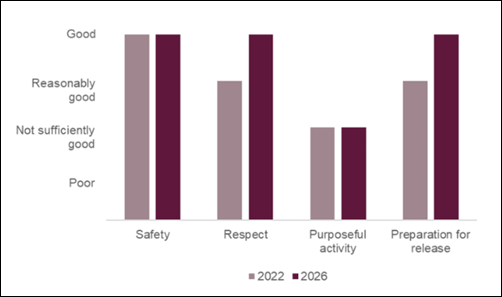
Figure 1. HMI Prisons healthy prison test outcomes (Source: HMP & YOI New Hall – HM Inspectorate of Prisons
Judgements are made against each healthy prison test and are supported by detailed narrative findings. Inspection reports provide an assessment of strengths, areas of concern, and priorities for improvement. Reports provide detailed explanation and evidence to support inspection findings rather than relying on a single headline judgement.
This approach reflects a view that complex organisations may be better understood through domain-level assessments and professional narrative rather than through a single overall rating.
His Majesty’s Inspectorate of Constabulary and Fire & Rescue Services (HMICFRS) (Back to top)
HMICFRS uses graded judgements across a range of inspection questions covering police effectiveness, efficiency, and legitimacy (PEEL). Forces receive graded judgements using the following scale:
- Outstanding
- Good
- Adequate
- Requires improvement
- Inadequate
The example below illustrates how HMICFRS presents graded judgements visually within published inspection reports.
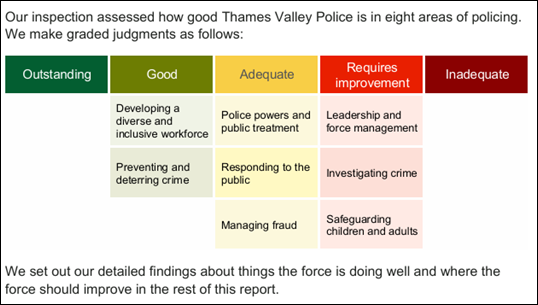
Figure 2. HMICFRS graded judgement profile (Source: PEEL 2025–2027: An inspection of Thames Valley Police)
Inspection findings are presented through individual judgements for separate areas of performance. Reports combine these judgements with supporting narrative, allowing strengths and weaknesses to be identified across different aspects of policing.
This approach reflects a view that graded judgements can help readers quickly identify strengths and weaknesses across multiple domains while maintaining transparency about inspection findings.
His Majesty’s Crown Prosecution Service Inspectorate (HMCPSI) (Back to top)
HMCPSI communicates inspection findings primarily through narrative assessment rather than visual grading systems or scorecards.
Inspection reports typically include:
- a summary of key findings
- an overall inspection judgement
- recommendations for improvement
- examples of effective practice
- detailed narrative analysis explaining the evidence underpinning findings.
Findings are supported by evidence gathered through case reviews, interviews, and document analysis.
This approach places emphasis on professional judgement, context, and explanation. It seeks to support understanding of performance through detailed narrative assessment rather than through ratings or comparative scores.
Ofsted (Back to top)
Historically, Ofsted used four headline grades: Outstanding, Good, Requires improvement, and Inadequate. Following recent reforms, Ofsted moved away from a single overall effectiveness judgement and proposed a report card model that assesses performance across a number of separate areas of provision rather than providing one overall grade.
Under the proposed model, individual aspects of a school’s performance would be assessed using a five-point scale ranging from ‘Urgent improvement’ to ‘Exceptional’. Rather than combining findings into a single overall judgement, the report card presents strengths and areas for improvement across different inspection areas.
The illustration below shows an example of how performance across multiple inspection areas is presented visually. This example illustrates Ofsted’s five-point report card framework, to demonstrate an alternative reporting format, and should not be interpreted as a preferred approach for HM Inspectorate of Probation. Respondents should consider the format rather than the specific inspection methodology used by Ofsted.
Figure 3. Ofsted five-point report card model (Source: Ofsted report cards: the 8 big changes you need to know)
The report card model provides separate assessments across a range of performance areas using a five-point scale. This enables strengths and areas for improvement to be presented individually rather than through a single overall judgement. The approach is intended to provide greater information about performance across different aspects of provision and reduce reliance on a single headline judgement. It reflects a wider interest within inspection and regulation in more nuanced reporting models.
Other regulators (Back to top)
Across government and public services, a variety of reporting approaches are now used. While some regulators continue to use ratings, others have adopted alternatives, including:
- report cards
- scorecards
- performance profiles
- dashboards
- domain-based assessments
- narrative performance summaries.
These approaches seek to provide stakeholders with a clearer understanding of performance across multiple areas while retaining accessibility and transparency. They allow strengths and areas requiring improvement to be presented separately rather than combined into a single headline judgement.
For example, the Care Quality Commission continues to use ratings supported by published evidence and detailed assessments, while bodies such as the National Audit Office communicate findings primarily through narrative reports and value-for-money assessments, without applying ratings.
In Wales, inspectorates and regulators such as Estyn, Healthcare Inspectorate Wales, Care Inspectorate Wales and Audit Wales similarly draw on detailed inspection findings, performance information and narrative reporting to communicate judgements and support improvement. Their approaches illustrate the diversity of reporting models used across public services and the increasing emphasis on providing a balanced assessment of strengths, risks and areas for development.
His Majesty’s Prison and Probation Service (HMPPS) scorecards (Back to top)
HMPPS uses performance scorecards to assess performance across a range of probation measures. Scorecard results are translated into a four-point rating framework using the descriptors ‘Outstanding’, ‘Good’, ‘Improvement Required and ‘Inadequate’. These ratings are derived from performance data and are used for performance management purposes rather than inspection judgements.
The continued use of these descriptors within the probation system means that they are already familiar to probation practitioners and leaders. This may support understanding of inspection findings where similar terminology is used. However, performance scorecards and inspection assessments measure different aspects of service delivery and should not be regarded as directly equivalent.
The examples above illustrate that, while some inspectorates and regulators are moving towards profile-based, report card or narrative approaches, rating frameworks continue to be used in parts of the wider probation system. This highlights the variety of approaches currently used to communicate performance and inspection findings.
Emerging themes (Back to top)
A review of approaches used across inspectorates and regulators suggests there is no single model that is universally adopted or regarded as best practice. This reflects wider findings from comparative studies of inspection and regulation, which show considerable variation in approaches to reporting and communicating inspection findings (National Audit Office, 2015; Criminal Justice Joint Inspectorates, 2026). Instead, organisations have developed reporting approaches that reflect their individual purposes and audiences.
However, several common themes emerge:
- a continued need for public accountability and transparent reporting
- recognition that complex services can be difficult to summarise through a single judgement
- growing interest in domain-based assessments and report-card approaches
- greater emphasis on narrative explanation and professional judgement
- increasing focus on supporting organisational learning and improvement alongside scrutiny
- recognition that language can influence how inspection findings are understood and received.
The evidence reviewed suggests that inspectorates across different sectors are seeking to strike a balance between simplicity and nuance. While headline judgements provide clarity and accessibility, more detailed approaches may offer a richer understanding of organisational performance. This consultation seeks views on how HM Inspectorate of Probation should balance these considerations in the future.
Chapter 4 – Principles (Back to top)
In developing potential future approaches, HM Inspectorate of Probation has adopted the following principles to inform this review:
- be clear and accessible
- support improvement
- maintain transparency and accountability
- command public and stakeholder confidence
- be evidence based and applied consistently
- be proportionate and practical to operate.
These principles have been informed by stakeholder engagement, comparator analysis, and recognised principles of public sector inspection (Criminal Justice Joint Inspectorates, 2026). They are intended to provide a framework against which potential future approaches can be considered. Regardless of the reporting model ultimately adopted, we believe these principles should remain central to how inspection findings are communicated.
Chapter 5 – Future models (Back to top)
The review has identified several possible approaches to the future communication of inspection findings.
Rather than presenting individual options, this consultation groups potential approaches into three broad models. These are intended to stimulate discussion and help respondents consider the relative strengths and limitations of different approaches.
Stakeholders may support one model, aspects of several models, or wish to suggest alternative approaches. The models presented are illustrative and should not be regarded as preferred options.
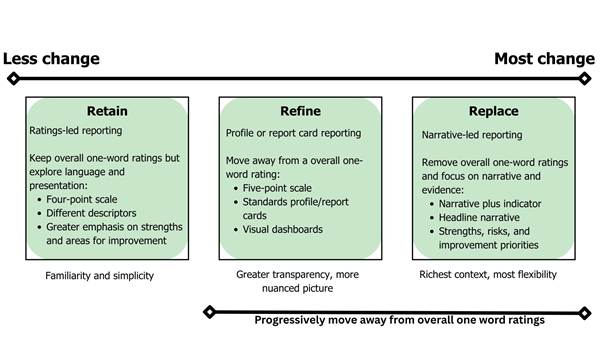
Figure 4. Three broad models for communicating inspection findings. These should be viewed as a spectrum of potential approaches, ranging from retaining the current ratings framework to moving towards predominantly narrative reporting
Model 1: Ratings-led reporting (Back to top)
This model would retain overall one-word ratings as the primary means of communicating inspection findings, while exploring whether the language, structure, and presentation of overall one-word ratings could be refined.
Possible variations could include:
- retaining an overall rating
- revising rating terminology
- four-point effectiveness scale
- increasing emphasis on strengths and areas for improvement alongside ratings
- using more action-focused terminology.
The example below illustrates how a ratings-led model could retain a four-point scale while adopting alternative terminology. The descriptors shown are illustrative only and should not be interpreted as a preferred option. A fuller illustrative example is provided at Annexe A.
Example 1:
| Current terminology | Illustrative alternative |
| Outstanding | 🟣 Strong |
| Good | 🟢 Sufficient |
| Requires improvement | 🟡 Needs attention |
| Inadequate | 🔴 Urgent improvement required |
Figure 5. Illustrative alternative rating terminology
| Potential benefits | Considerations |
| Familiar to stakeholders | May oversimplify complex findings |
| Simple to understand | Focus may remain on labels rather than evidence |
| Supports public accountability | Strengths and weaknesses may be obscured by an overall judgement |
| Facilitates comparison between inspections | Potential impacts on morale and organisational learning |
| Easier communication of inspection outcomes |
Model 2: Profile or report card reporting (Back to top)
This model would move away from an overall one-word rating and instead present a profile of performance across individual inspection standards. Findings would be communicated through a combination of standards-level assessments, visual summaries, and supporting narrative.
Possible features could include:
- introduction of a five-point scale
- standards-level assessments
- report cards or performance profiles
- visual dashboards or scorecards
- short headline summaries of strengths and areas for improvement.
The example below illustrates how inspection findings could be presented through a standards profile rather than an overall judgement. Assessment is provided against individual inspection standards, enabling strengths and areas requiring improvement to be identified separately. The example is illustrative only and should not be interpreted as a preferred option. A fuller illustrative example is provided at Annexe A.
Example 2:
Headline narrative
The inspection found strong leadership and effective delivery across most standards. However, improvement is required in staffing capacity and workforce resilience.
| Inspection standard | Assessment |
| Leadership | 🔵 Strong |
| Staffing | 🟡 Needs attention |
| Services | 🟢 Sufficient |
| Assessment | 🟢 Sufficient |
| Planning | 🔵 Strong |
| Delivery | 🟢 Sufficient |
| Reviewing | 🟢 Sufficient |
Figure 6. Illustrative standards profile
| Potential benefits | Considerations |
| Greater transparency about performance across different standard | May be less familiar than a single overall rating |
| Clearer identification of strengths and areas requiring improvement | Requires readers to interpret a greater volume of information |
| Reduced emphasis on a single headline judgement | May be more difficult to communicate through headlines and media reporting |
| More nuanced understanding of organisational performance | Comparisons between organisations may be less straightforward |
| Visual presentation that remains accessible to specialist and non-specialist audiences | Stakeholders may place differing emphasis on individual standards |
Model 3: Narrative-led reporting (Back to top)
This model would move away from ratings and communicates inspection findings primarily through narrative assessment.
Rather than assigning grades or ratings, reports would focus on explaining the evidence gathered during inspection activity, highlighting strengths, key concerns, and priorities for improvement.
The illustration below provides an example of how inspection findings could be communicated through narrative summaries rather than ratings or graded assessments. The example is illustrative only and should not be interpreted as a preferred option. A fuller illustrative example is provided at Annexe A.
Example 3: Headline narrative
The inspection identified strengths in leadership, partnership working, and service delivery. However, staffing pressures and inconsistency in assessment practice were affecting the quality and consistency of outcomes in some areas.
| Area | Summary of findings |
| Leadership | Leaders provided clear direction and staff reported feeling supported |
| Staffing | Capacity pressures affected consistency in some teams |
| Services | Services generally met the needs of people on probation |
| Assessment | Assessment practice was variable, with examples of both strong and weaker practice |
| Planning | Planning arrangements were usually completed to the required standard |
| Delivery | Service delivery was generally effective, although some inconsistency remained |
| Reviewing | Review processes provided appropriate oversight in most cases |
| Potential benefits | Considerations |
| Richer context | Reduced simplicity |
| Greater focus on evidence and professional judgement | Potential inconsistency in interpretation |
| Reduced focus on labels | More difficult comparisons between inspections |
| Stronger emphasis on organisational learning and improvement | Key findings may be less visible to non-specialist audiences |
Chapter 6 – Language (Back to top)
Throughout our engagement activity with stakeholders, questions have been raised about the language used to describe inspection outcomes.
HM Inspectorate of Probation currently uses four ratings (both overall one-word ratings and standards ratings):
- Outstanding
- Good
- Requires improvement
- Inadequate.
These ratings have been used across our inspection programmes and are a familiar feature of inspection reporting. While inspection judgements are based on detailed evidence, ratings are often among the most visible aspects of inspection findings for stakeholders, practitioners, and the public.
Research and stakeholder engagement have highlighted differing perceptions regarding the language used to communicate inspection outcomes and ratings (Wallace, 2026). Some considered it clear and readily understood, while others questioned whether alternative language might better reflect inspection findings and organisational performance.
Language can influence how inspection outcomes are understood and interpreted by different audiences. An important consideration is whether the terminology used accurately reflects the evidence gathered through inspection and can be understood consistently by stakeholders.
We are therefore interested in understanding whether the current terminology remains appropriate and, if not, whether alternative language might communicate inspection findings and organisational performance more effectively.
The examples below illustrate different approaches that could be used to communicate inspection outcomes. They are intended solely to support consultation and should not be regarded as preferred options. Respondents may support one approach, elements of several approaches, or propose alternatives.
| Current terminology | Performance-focused terminology | Improvement-focused terminology | Neutral descriptive language |
| Outstanding | Strong | Exemplary practice | Strong evidence or sufficient practice |
| Good | Sufficient | Sufficient practice | Evidence of sufficient practice |
| Requires improvement | Needs attention | Improvement required | Mixed evidence of effective practice |
| Inadequate | Urgent improvement required | Significant improvement required | Significant concerns identified |
Chapter 7 – Consultation questions (Back to top)
This consultation seeks views on the future communication of inspection findings by HM Inspectorate of Probation. We are seeking your responses to consultation questions on future reporting model, overall one-word ratings, the information that stakeholders require, and the language used to communicate inspection outcomes.
Responses will help inform HM Inspectorate of Probation’s consideration of future reporting arrangements. No decisions have been made, and all responses will be carefully considered alongside wider evidence gathered through this review.
Before responding to the consultation questions, respondents may wish to review:
- Chapter 5, which sets out three broad illustrative models for communicating inspection findings
- Chapter 6, which considers alternative approaches to terminology
- Annexe A, which provides fuller illustrative examples of alternative reporting models and terminology.
We welcome responses to all questions. However, respondents do not need to answer every question and may respond only to those areas where they have views or relevant experience.
References
Criminal Justice Joint Inspectorates. (2026). The 10 Principles of Public Sector Inspection. Available at:The 10 principles of public sector inspection – Criminal Justice Joint Inspectorates (Accessed: 8 August 2026).
HM Inspectorate of Prisons. (2022). Why HMI Prisons is Proposing to Stop Making Recommendations. Available at: https://hmiprisons.justiceinspectorates.gov.uk (Accessed: 8 August 2026)
HM Inspectorate of Probation. (2017). Consultation on Standards and Ratings for Inspecting Probation Services. Available at: A consultation on standards and ratings for a national inspection of the Probation Service – HM Inspectorate of Probation (Accessed: 31 July 2026).
HM Inspectorate of Probation. (2023). The History of HM Inspectorate of Probation. Manchester. Available at: https://cdn.websitebuilder.service.justice.gov.uk/uploads/sites/32/2025/03/The-history-of-HMI-Probation.pdf (Accessed: 31 July 2026)
HM Inspectorate of Probation. (2025). Standards and Ratings. Available at: Standards and ratings – HM Inspectorate of Probation (Accessed: 25 July 2026).
HM Inspectorate of Probation (2026) Serious Further Offence reviews. Available at: https://hmiprobation.justiceinspectorates.gov.uk/about-us/our-inspections/sfo-reviews/(Accessed: 8 September 2026).
National Audit Office. (2015). Inspection: A Comparative Study. Available at: Inspection: A comparative study (Accessed: 25 July 2026).
Wallace, N. (2026). Exploring Perceptions of the Ratings, One-Word Judgments and Effectiveness of Recommendations in Probation Service Inspections in the Context of Other Criminal Justice Inspections. University of Cambridge dissertation.
Annexe A – Illustrative examples of alternative approach models (Back to top)
The examples in this annexe are intended solely to illustrate how inspection findings might be communicated under different reporting models. They are not proposals and should not be interpreted as preferred options. Respondents may support one model, elements of several models, or alternative approaches.
Model 1: Ratings-led reporting (Back to top)
Example 1. Retain the overall rating while adopting alternative terminology to describe inspection outcomes. The assessment framework remains unchanged.
| Current terminology | Illustrative alternative |
| Outstanding | 🟣 Strong |
| Good | 🟢 Sufficient |
| Requires improvement | 🟡 Needs attention |
| Inadequate | 🔴 Urgent improvement required |
Example (approved premises inspection):
Fieldwork started August 2026 Score 8/12
🟢 Overall rating: Effective
The approved premises is delivering some effective services in challenging circumstances. Staff provide high-quality support and risk management, supported by strong leadership and positive relationships with residents. Improvements are needed to address environmental issues and strengthen some partnership arrangements.
| Area | (Illustrative) Outcome |
| Overall rating | 🟢 Sufficient |
| Leadership and governance | 🟡 Developing |
| Staffing | 🟢 Effective |
| Safety | 🟡 Developing |
| Public protection | 🟢 Sufficient |
Model 2: Profile/report card reporting (Back to top)
Example 2. Replace the overall one-word rating with standards-level assessments using a five-point effectiveness scale. Findings are communicated through an inspection profile showing performance against individual inspection standards.
| (Illustrative) Rating | (Illustrative) Definition |
| 🟣 Exemplary | Practice consistently delivers exceptional outcomes and demonstrates sector-leading strengths |
| 🔵 Strong | Practice exceeds expected standards and consistently delivers positive outcomes |
| 🟢 Sufficient | Practice meets expected standards and delivers the quality of service expected |
| 🟡 Needs attention | Important weaknesses are evident and improvement is required |
| 🔴 Urgent improvement required | Serious or systemic weaknesses undermine delivery and outcomes. |
Example (adult probation services inspection):
Inspection profile
The inspection found strong leadership and effective delivery across most standards. However, improvement is required in staffing capacity and workforce resilience.
| Inspection standard | Assessment |
| Leadership | 🔵 Strong |
| Staffing | 🟡 Needs attention |
| Services | 🟢 Sufficient |
| Assessment | 🟢 Sufficient |
| Planning | 🔵 Strong |
| Delivery | 🟢 Sufficient |
| Reviewing | 🟢 Sufficient |
Example 3. Remove the overall rating and present a visual profile of standards-level judgements supported by a short headline assessment.
Headline assessment:
The inspection found effective performance across most standards, with strengths in public protection and leadership. Improvement is required in sentence planning and partnership engagement.
| Outstanding |
| Good🟢 🟢 🟢 🟢 🟢 |
| Requires improvement 🟡 🟡 |
| Inadequate |
Explanation of ratings
| Leadership | 🟢 Good (narrative underneath) |
| Staffing | 🟡 Requires improvement (narrative underneath) |
| Services | 🟢 Good (narrative underneath) |
| Assessment | 🟢 Good (narrative underneath) |
| Planning | 🟢 Good (narrative underneath) |
| Delivery | 🟡 Requires improvement (narrative underneath) |
| Reviewing | 🟢 Good (narrative underneath) |
Model 3: Narrative-led reporting (Back to top)
Example 4. Remove ratings and communicate inspection findings through narrative reporting. Findings are presented through a headline assessment, narrative summaries across inspection areas, identified strengths, areas requiring improvement, and improvement priorities.
Headline narrative
The inspection identified strengths in leadership, partnership working, and service delivery. However, staffing pressures and inconsistency in assessment practice were affecting the quality and consistency of outcomes in some areas.
| Area | Summary of findings |
| Leadership | Leaders provided clear direction and staff reported feeling supported |
| Staffing | Capacity pressures affected consistency in some teams |
| Services | Services generally met the needs of people on probation |
| Assessment | Assessment practice was variable, with examples of both strong and weaker practice |
| Planning | Planning arrangements were usually completed to the required standard |
| Delivery | Service delivery was generally effective, although some inconsistency remained |
| Key strengths | Areas requiring improvement | Improvement priorities |
| Leadership and strategic direction | Staffing capacity | Strengthen workforce resilience |
| Partnership working | Assessment quality | Improve assessment practice |
| Quality of service delivery | Consistency of practice | Enhance quality assurance arrangements |
Annexe B – Equality accessibility considerations (Back to top)
HM Inspectorate of Probation has undertaken an Equality Impact Assessment (EIA) to consider the potential implications of the approaches described in this consultation. At this stage, no decisions have been made regarding future reporting arrangements.
The EIA has informed the development of this consultation and will continue to be reviewed alongside consultation responses and other evidence gathered through the review process.
We welcome comments on any equality, diversity, inclusion or accessibility considerations that respondents believe should be taken into account when determining how inspection findings are communicated in the future.